
Listening for What Really Matters
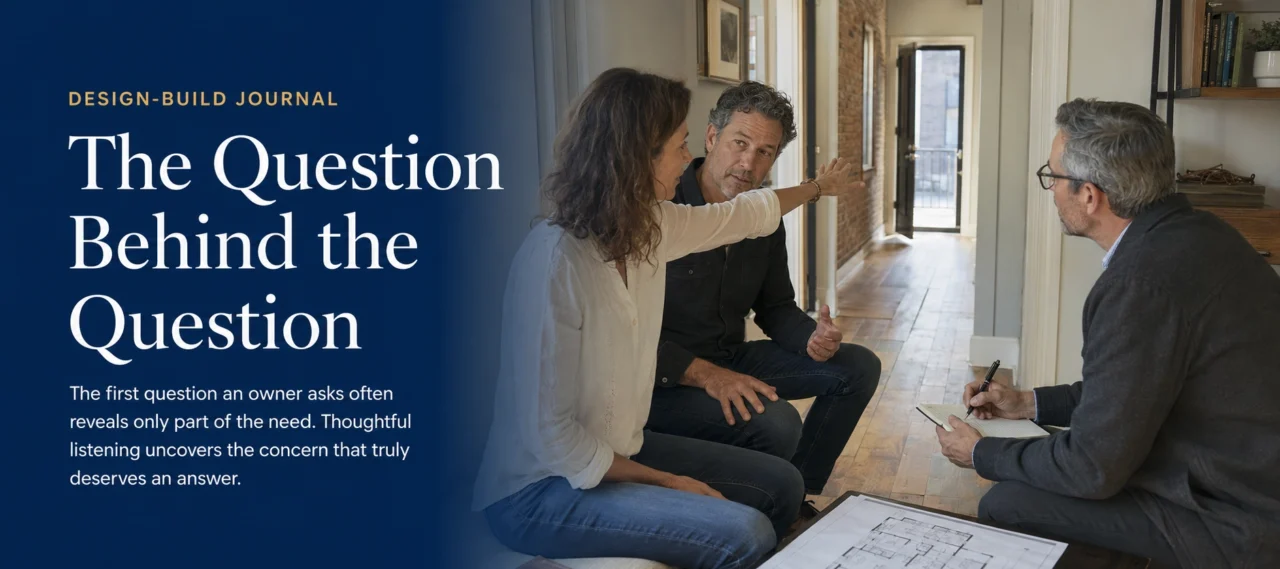
After years of meeting with homeowners and business owners, we have learned that the first question is not always the real question.
A homeowner may ask, “How much will this cost?” Another wants to know whether a wall can be removed. Someone else asks how long the project will take or whether an addition is possible on the property. These are all important questions, and each deserves a thoughtful answer. Yet experience has taught us that they are often only the beginning of the conversation.
Behind almost every practical question lies something more personal. The homeowner asking about cost may really be wondering whether the project is financially responsible for the family. The person asking about removing a wall may not be particularly interested in the wall itself. The underlying desire may be to create a home where conversations are easier, grandchildren can be watched from the kitchen, or everyday life feels less divided.
A business owner asking about a renovation schedule may actually be concerned about continuing to serve customers without unnecessary disruption. The stated question may focus on timing, while the deeper concern involves protecting relationships, maintaining revenue, or preparing the company for future growth.
The project itself is rarely the only subject being discussed.
Why the First Answer May Not Be Enough
It is tempting to answer the question that was asked as quickly as possible. A direct question seems to invite a direct response, and providing one can feel helpful. The difficulty is that a technically correct answer may still fail to address what the owner genuinely needs to understand.
A wall may be removable, but removing it may not create the experience the homeowner hopes to achieve. An addition may be physically possible, but it may not be the best way to improve the building. A preliminary budget may be offered, but the number may provide little meaningful guidance until the priorities, conditions, and intended outcome have been more clearly defined.
This is one reason thoughtful planning begins with listening rather than explaining. The purpose of the early conversation is not simply to collect enough information to produce an answer. It is to understand why the question matters.
Better Questions Create Better Conversations
A more productive conversation often begins by asking another question in return:
What prompted you to start thinking about this project? What is not working today? How is that affecting the people who use the building? If we met again a year after construction was complete, what would make you say the project had been worthwhile?
Questions like these often change the direction of the discussion. Instead of focusing immediately on products, prices, or construction methods, the conversation begins exploring priorities, expectations, concerns, and long-term goals.
This is where Design Is Decision Making begins. Design does not start with a drawing or a proposed solution. It starts by establishing what the project must accomplish so that later choices can be evaluated against a shared purpose.
The technical aspects of the project remain important, but they are now guided by a clearer understanding of the outcome the owner hopes to achieve. Decisions become easier because they are connected to a purpose rather than treated as a collection of isolated requirements.
Listening Is More Than Gathering Information
Every experienced Design-Build professional eventually discovers that listening is far more than gathering facts. It is the process of uncovering the purpose that gives every later decision its meaning.
Owners do not always arrive with the language needed to describe that purpose. They may describe a room, a structural change, a schedule, or a particular finish because those are the most visible parts of the project. A thoughtful project team listens for the needs and concerns beneath those requests.
That deeper understanding also reduces uncertainty. When the team understands why an outcome matters, it can identify alternatives, explain tradeoffs, and recognize risks that might otherwise remain hidden. As explored in Managing Risk Through Understanding, better decisions become possible when everyone is working from the same understanding of the project and its priorities.
Listening therefore does more than improve the relationship between the owner and the project team. It directly influences design quality, budget decisions, coordination, and construction outcomes.
The Best Projects Begin with the Best Questions
Looking back, we have found that the most successful projects rarely begin with the best answers. They begin with the best questions.
Once the purpose behind the project is understood, many of the questions that seemed most important at the beginning gradually answer themselves. The appropriate scope becomes clearer. Priorities begin to separate from preferences. Design alternatives can be compared meaningfully, and financial decisions can be evaluated according to what they contribute to the desired outcome.
This does not mean that every decision becomes easy. Construction projects still involve constraints, compromises, and competing priorities. However, those decisions become more coherent because the people making them understand what they are trying to accomplish together.
A Final Thought
The first question deserves respect because it starts the conversation. The question behind it deserves even greater attention because it reveals where the conversation truly needs to go.
When we understand what people are really trying to accomplish—not simply what they are asking—we place ourselves in a much better position to help them make decisions they will continue to appreciate long after construction is complete.
Continue Exploring the Design-Build System
Thoughtful listening establishes the purpose that guides every later project decision. Explore Design Is Decision Making to understand how clearly defined priorities shape design, budgeting, and construction. You can also examine Managing Risk Through Understanding or return to the complete Design-Build Foundation Guides.