
A Better Project Begins With a Better Structure
Every construction project begins with an idea. A homeowner may imagine a kitchen that finally supports the way the family gathers, an addition that creates room for a changing household, or a complete renovation that gives an aging property new purpose. A business owner may need a workplace that supports growth, improves operations, or presents the company more effectively to its customers.
The idea may be clear, but the path from that idea to a completed project often is not. Design decisions affect cost, budget decisions affect materials, existing conditions affect engineering, and engineering affects construction. Each choice influences the choices that follow, and uncertainty grows when the people responsible for those decisions work separately.
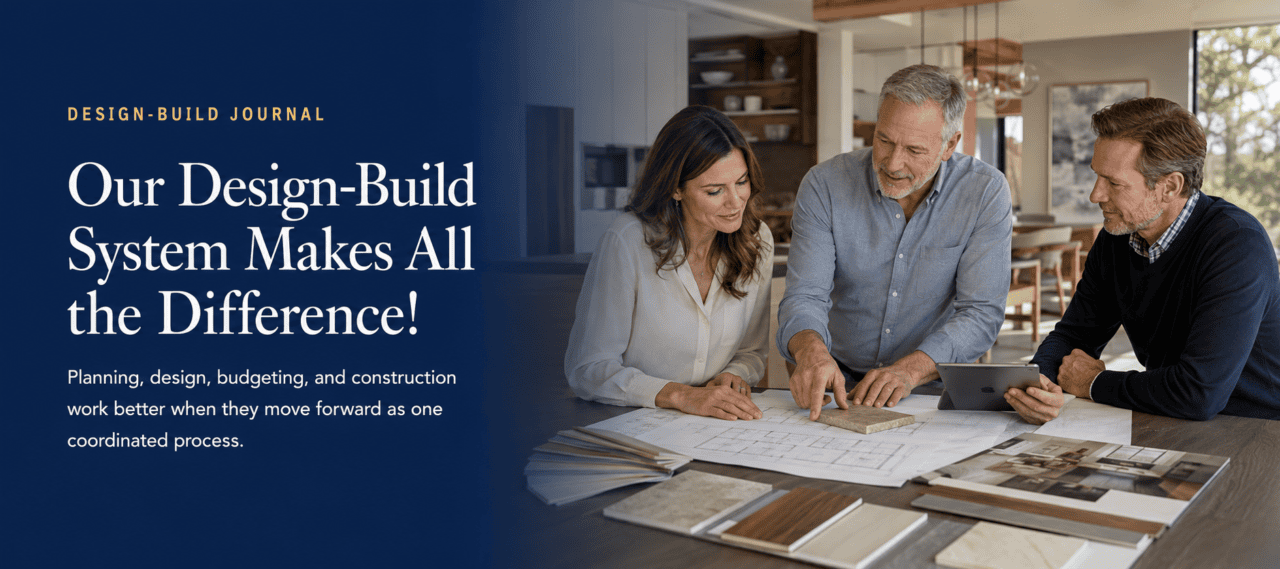
The Design-Build System creates a more coherent path. It brings planning, design, budgeting, and construction together within one coordinated process so the project can be understood as a whole before it is built. That coordination makes all the difference.
The Traditional Separation Between Design and Construction
In a traditional design-bid-build arrangement, the owner first works with an architect or designer to develop drawings. Contractors are invited to price those drawings later, often after substantial design work has already been completed.
This arrangement can appear orderly because each professional has a clearly defined role. The difficulty is that design and construction are treated as separate stages even though they are deeply connected.
A design decision may look appropriate on paper but exceed the owner’s budget when contractors finally price it. A material may support the intended appearance but create unexpected installation requirements. An existing structural condition may require a different solution than the drawings anticipated. When these realities emerge late, the project may need to be redesigned, reduced in scope, delayed, or rebid.
The professionals involved may each have performed their individual responsibilities properly. The underlying problem is that the process did not allow the most important decisions to be evaluated together early enough. The Foundation Guide Design-Build vs. Design-Bid-Build examines how the structure of each approach influences communication, responsibility, and decision-making.
Design-Build changes that structure.
One Team Working Toward One Understanding
Under the Design-Build System, the owner does not have to coordinate separate groups working with different information, assumptions, and priorities. Designers, builders, estimators, trade partners, and other specialists contribute to one connected process.
This does not mean that everyone performs the same role. Architects still provide architectural expertise. Designers still shape space, function, materials, and appearance. Builders still evaluate constructability, sequencing, labor, and field conditions. Engineers and trade professionals still contribute specialized knowledge.
The difference is that their knowledge is brought together while decisions are being made. When the designer proposes an idea, the construction team can evaluate how it may be built. When the estimator identifies a cost concern, the design team can explore alternatives before the owner becomes committed to a single solution. When an existing condition creates uncertainty, the team can investigate it before construction begins whenever reasonably possible.
As explained in What Is Design-Build?, the owner receives more than a collection of professional opinions. The owner receives a coordinated understanding of the project.
Preconstruction Is Where the Project Takes Shape
Many people think construction begins when demolition starts or equipment arrives at the property. In reality, the direction of the project is established much earlier.
Preconstruction is the period in which the team works to understand what the owner wants to accomplish, what the property will support, what the work is likely to cost, and what must be resolved before construction can proceed responsibly.
This work may include existing-condition documentation, site investigation, feasibility studies, preliminary design, engineering consultation, material research, trade-partner input, permitting analysis, scheduling, and progressive cost development. The exact activities vary according to the size and complexity of the project, but the purpose remains consistent: replace assumptions with useful information.
A strong preconstruction process does not promise that construction will contain no surprises. Existing buildings and active project sites can always reveal conditions that could not reasonably be seen beforehand. The goal is to identify foreseeable questions early, reduce avoidable uncertainty, and establish a practical response to the risks that remain.
That preparation creates the foundation for more confident decisions. Preconstruction: Where Successful Projects Begin explores this stage in greater detail.
Budgeting Becomes Part of Design
Budget conversations are often treated as a restriction on creativity. In a thoughtful Design-Build process, budgeting serves a more constructive purpose. It helps the team direct creativity toward solutions the owner can realistically pursue.
An early budget is not the same as a final construction price. At the beginning of a project, many details have not yet been determined, and responsible professionals should not pretend otherwise. The budget develops as the design becomes clearer, the scope becomes more complete, and the team learns more about the property.
This progressive approach allows design and cost to inform one another. If an early concept appears likely to exceed the intended investment, the team can identify the pressure before completing the entire design. If an important feature adds cost, the owner can evaluate its value in relation to other priorities. If a different material or construction method can achieve the same purpose more effectively, it can be considered while choices remain open.
The objective is not simply to make the project less expensive. It is to align the available investment with the outcomes that matter most. This is one of the central principles examined in The Economics of Better Planning.
Better Communication Produces Better Decisions
Construction is often described as a technical process, but it is equally a communication process. Drawings, specifications, budgets, schedules, selections, meeting notes, and field conversations all transfer decisions from one person to another.
When those communications are fragmented, details can be interpreted differently. The designer may be working from one assumption while the estimator is working from another. The owner may believe something is included that the builder considers undecided. A trade partner may receive information that no longer reflects the current design.
The Design-Build System establishes clearer lines of responsibility. Information moves through one coordinated team, and changes can be evaluated for their effect on design, cost, schedule, and construction before they are approved.
This does not eliminate the owner’s responsibility to make decisions. It improves the quality of the information available when those decisions must be made.
Risk Is Managed Upstream
Every construction project contains risk. Properties have physical limitations, existing buildings can conceal damage or outdated construction, and permit requirements can change the path forward. Material availability, engineering discoveries, and owner-directed changes can also affect cost and timing.
The question is not whether risk exists. The more useful question is when the team will confront it.
In a fragmented process, important risks may remain hidden until construction forces them into view. At that point, the owner has fewer alternatives and less time to consider them. In Design-Build, the team moves as much investigation and decision-making as practical into preconstruction, when adjustments are generally easier and less disruptive.
A line moved on a drawing may require a conversation. The same line moved after walls have been built may require demolition, new materials, additional labor, schedule changes, and revised inspections.
Managing risk upstream means applying effort when it has the greatest ability to protect the project. Managing Risk Through Understanding explains why uncertainty becomes more manageable when it is identified and discussed before commitments are made.
A Smoother Construction Experience
The value of Design-Build becomes especially visible during construction, but much of that value was created earlier. A coordinated design gives the field team clearer direction. Completed selections reduce unanswered questions. Trade input improves sequencing and constructability. A developed scope makes responsibilities easier to understand, and a realistic budget gives the owner a stronger basis for financial preparation.
Construction will still involve noise, activity, temporary inconvenience, and decisions. A renovation may still uncover conditions that could not be detected before work began. A commercial project may still require coordination around ongoing operations. Design-Build does not make construction effortless.
It makes the experience more manageable because the project begins with greater alignment. When an issue does arise, the people responsible for design and construction are already working within the same system. The team can examine the issue together, understand its broader consequences, and present the owner with a coordinated path forward.
The System Serves Both Homes and Businesses
Residential and commercial projects are different in many important ways. A home is deeply personal and must support daily life, family relationships, comfort, and long-term plans. A commercial space must support operations, employees, customers, regulatory requirements, brand identity, and financial performance.
Yet both types of owners benefit from the same underlying principles. They benefit when the team listens before proposing solutions, when design is informed by construction knowledge, and when budgets develop alongside the scope. They also benefit when risks are investigated before commitments become difficult to change.
Most of all, owners benefit when the professionals involved share responsibility for understanding the entire project. Design-Build provides a structure through which those principles can guide the work.
The Greatest Difference Is Clarity
A successful project is not created by drawings alone, and it is not created by construction alone. It emerges from a sequence of connected decisions made with increasing levels of understanding.
The Design-Build System organizes that sequence. It helps owners move from an initial idea to a defined purpose, from purpose to design, from design to an informed investment, and from planning to coordinated construction.
The visible result may be a transformed home, an addition, a new building, or a commercial renovation. The less visible result is the clarity that allowed the owner and project team to reach that outcome together.
That is why our Design-Build System makes all the difference.
A Final Thought
A better project requires more than talented individuals performing separate responsibilities. It requires a structure that allows their knowledge to influence the project at the right time.
Design-Build creates that structure. By connecting owner priorities, design thinking, construction knowledge, financial information, and technical expertise from the beginning, it gives the project a clearer path from possibility to completion.
Continue Exploring the Design-Build System
A coordinated project begins by bringing planning, design, budgeting, and construction into one connected process. Explore What Is Design-Build? for an introduction to this approach. You can also examine The Design-Build Process or return to the complete Design-Build Foundation Guides.