
The Conversation Usually Begins Somewhere Else
One of the questions we are most often asked is, “How much will this project cost?” It is an important question, and every construction project must eventually answer it. Homes and commercial buildings represent significant investments, and responsible planning requires a realistic understanding of the financial commitment involved.
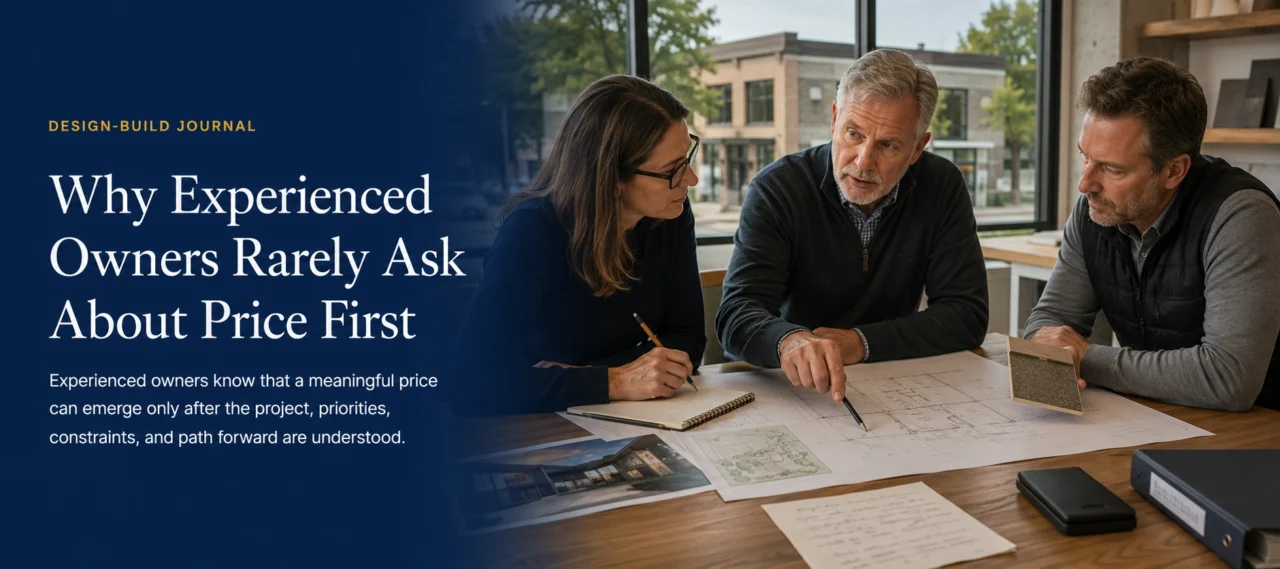
What has surprised us over the years, however, is how rarely experienced owners begin there. After hundreds of conversations, a pattern emerges. People who have completed successful projects in the past seldom open the discussion by asking about price alone. Instead, they begin by describing what they hope will be different when the project is finished.
A homeowner may explain that the kitchen no longer supports family gatherings because everyone feels separated into different rooms. Another may describe how an aging home no longer works comfortably for the way the family lives today. A business owner may talk about a growing team that has outgrown its current workspace or a facility that no longer reflects the company’s direction.
These conversations naturally center on problems to solve, opportunities to create, and goals to accomplish. Only after those priorities become clear does the discussion of budget begin to take its proper place.
Price Needs Context
This progression is not accidental. Experienced owners understand that price has meaning only after the project’s purpose has been clearly defined. Until everyone shares the same understanding of what the project is intended to accomplish, any discussion about cost remains incomplete because it lacks the context needed to evaluate value.
A preliminary number may sound attractive or intimidating, but neither reaction reveals whether the number represents the right project. The owner and project team must first understand the desired outcome, existing conditions, functional priorities, technical requirements, and decisions that will shape the work. The principles examined in Managing Risk Through Understanding begin here: uncertainty becomes more manageable when the people involved develop a shared understanding before making commitments.
This does not mean that budget should be postponed or treated as secondary. Budget must be introduced early, but it needs something meaningful to respond to. Without a clear purpose, a budget is simply a limit. With a clear purpose, it becomes a planning tool.
Budget as a Decision-Making Tool
Once the project’s priorities have been established, the character of the financial conversation changes. Rather than treating budget as the starting point for every decision, the team can use it to evaluate which choices contribute most directly to the owner’s goals.
Design alternatives can be compared according to both cost and consequence. Investments in structure, function, durability, efficiency, or long-term adaptability can be weighed against finishes or features that may contribute less to the project’s central purpose. The question is no longer simply, “How much does this cost?” It becomes, “What does this decision accomplish, and is that contribution worth the investment?”
This is the foundation of The Economics of Better Planning. Thoughtful planning does not make every project inexpensive, nor does it eliminate difficult financial decisions. It helps owners direct their available resources toward the decisions that matter most while identifying compromises before they become expensive construction changes.
Financial discussions become more productive because they are no longer abstract. Every investment can be evaluated according to the contribution it makes toward the owner’s priorities and long-term goals.
What Experience Teaches Owners
Looking back, we have found that this is one of the key differences between first-time owners and those who have already experienced a successful construction project. Experience teaches that construction is not purchased in the same way someone buys an appliance or a piece of furniture.
A construction price cannot be separated from the scope, assumptions, exclusions, existing conditions, design development, material expectations, and level of coordination behind it. Two numbers that appear to describe the same project may represent very different understandings of what will actually be designed and built.
Experienced owners therefore tend to ask broader questions. They want to understand how the team approaches planning, how decisions will be coordinated, when reliable pricing can be developed, and how uncertainty will be addressed. They recognize that a low preliminary number offers little protection if it was created before the project was sufficiently understood.
Construction is the process of creating a place that will continue serving people for many years. Once that perspective develops, the first conversation naturally becomes less about “What will it cost?” and more about “What are we trying to accomplish?”
That shift often becomes the beginning of a much better project.
A Final Thought
We have learned that conversations about price become much more productive after everyone agrees on what success looks like. Budgets are important because they shape decisions, but priorities give those decisions meaning.
When owners begin by defining what they hope to accomplish rather than simply asking what it will cost, the planning process becomes clearer and calmer. The resulting budget is not merely a number attached to an undefined idea. It reflects a project that has been examined, discussed, and aligned with the outcome the owner values.
Continue Exploring the Design-Build System
A reliable budget develops from a reliable understanding of the project. Explore The Economics of Better Planning to learn how early decisions protect resources and improve value. You can also examine Managing Risk Through Understanding or return to the complete Design-Build Foundation Guides.