
Questions Are a Sign of Experience
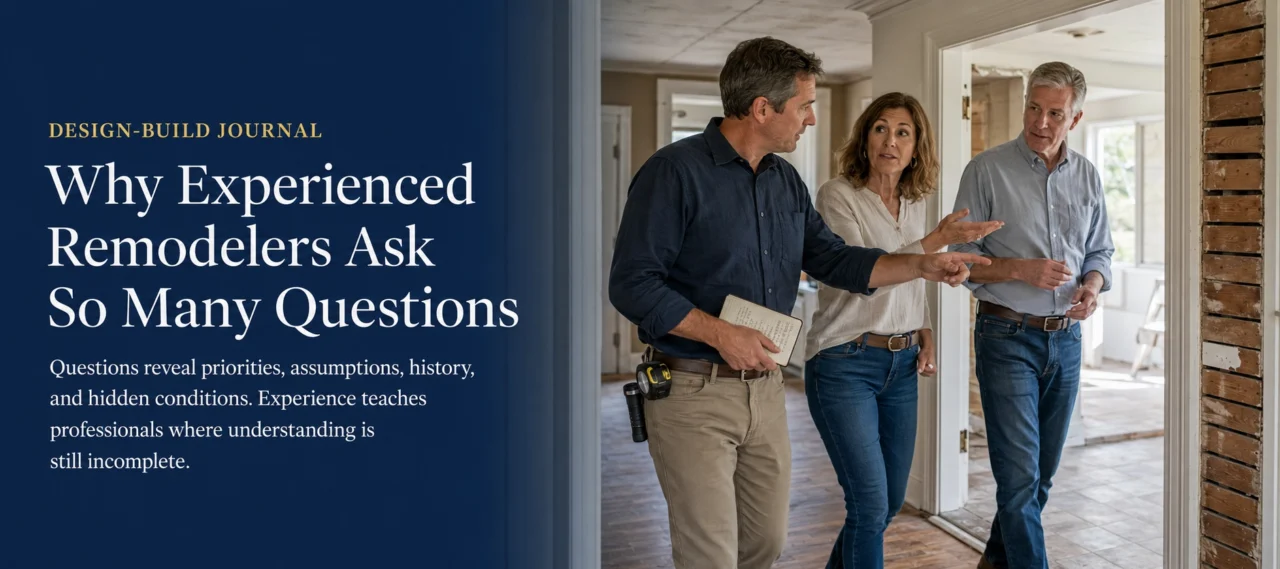
When owners first meet with an experienced remodeler, they may be surprised by how many questions arise. What prompted the project? What is not working today? How old is the home, and has it been remodeled before? Which spaces matter most, how does the family use them, and what should remain unchanged? What concerns do the owners have about budget, schedule, disruption, or future needs?
Some questions may appear unrelated to the work being discussed, while others may seem more detailed than the project requires at such an early stage. The questions are not evidence that the remodeler lacks answers. They are evidence that experience has taught the remodeler not to answer too quickly.
Existing Buildings Resist Assumptions
Remodeling differs from new construction because the project must respond to a building that already exists. The home contains an established structure, utility systems, materials, construction methods, and history. Some of those conditions are visible, while others remain concealed behind walls, ceilings, floors, and finishes.
A request that sounds straightforward may be affected by conditions the owner has never had a reason to consider. Removing a wall can involve structural loads, electrical wiring, plumbing, ductwork, flooring, ceiling transitions, and adjacent finishes. Relocating a kitchen can affect utilities, ventilation, windows, circulation, and the relationship among several rooms.
Experienced remodelers ask questions because they understand how much can be hidden inside a simple request. They want to identify the relationships surrounding the work before allowing an early idea to become an unsupported assumption.
The Same Request Can Mean Different Things
Two homeowners may both say they want an open kitchen, yet the projects they imagine may be completely different. One may want better visibility while children play in the adjoining room, while another may want space for entertaining large groups. One may prefer a completely open plan, while another wants greater connection without exposing every part of meal preparation. The same words can represent very different priorities.
Questions uncover those differences. How many people typically use the kitchen? What happens there besides cooking? Should guests gather near the work area or remain outside it? Is storage more important than seating? Does the family value visual openness, acoustic separation, or flexibility?
The remodeler cannot recommend the right solution until the purpose behind the request becomes clear. Understanding what the owner hopes to accomplish allows the design to respond to the actual need rather than merely repeating the first solution mentioned.
Questions Reveal Priorities
Every project contains more possibilities than can or should be pursued. Owners may want improved function, additional space, better light, updated materials, greater accessibility, stronger connection, increased privacy, and long-term flexibility. Budget, property conditions, schedule, and existing structure will influence how those goals can be addressed.
Questions help establish a hierarchy. If the project must make one improvement exceptionally well, what should it be? Which frustrations affect everyday life most often? Which elements are preferences, and which are essential? How long do the owners expect to remain in the home, and are future phases being considered?
Clear priorities allow the project team to evaluate alternatives meaningfully. Without them, every idea competes equally and the design can become a collection of features without a central purpose.
Preconstruction Begins with Curiosity
The questions asked during early conversations become the beginning of Preconstruction: Where Successful Projects Begin. Preconstruction is sometimes mistaken for a purely technical phase involving drawings, engineering, pricing, and permits. Those activities are important, but they depend upon a more fundamental task: developing a reliable understanding of the project.
That understanding begins through curiosity. The team asks about the owners, the building, the desired outcome, known problems, earlier renovations, and areas of uncertainty. Those answers guide site investigation, design development, consultant involvement, budgeting, and the sequence of later decisions.
The quality of preconstruction depends partly upon the quality of the questions that initiate it. Better questions lead the team toward the information that must be developed before responsible commitments can be made.
Technical Questions Protect the Design
As planning develops, the questions become increasingly specific. How is the existing structure carrying its loads? Where do utility systems run? Will the proposed material work with the existing substrate? How will water be managed? What clearances are required? Does the selected equipment affect electrical service, ventilation, or cabinetry?
These questions are not intended to weaken the design by emphasizing limitations. They help the team find a buildable path that preserves the design’s purpose.
A technically unresolved idea remains vulnerable because it may need to be changed after pricing, permitting, material ordering, or construction has begun. When technical questions are addressed early, design intent and construction reality can develop together instead of confronting one another later.
Financial Questions Create Clarity
Experienced remodelers also ask questions about budget. These conversations can feel uncomfortable because owners may worry that sharing a budget will limit creativity or weaken their negotiating position. The remodeler, however, cannot responsibly guide scope and design without understanding the financial framework within which decisions must be made.
The important question is not simply, “What is your budget?” A meaningful financial conversation explores what the owner expects the investment to accomplish, which priorities deserve protection, how much uncertainty is acceptable, and where flexibility may exist.
Questions about budget allow the team to align ideas with resources before significant effort is invested in a direction that cannot be supported. They help transform budget from an isolated number into a tool for evaluating priorities and alternatives.
Questions Help Identify Risk
Remodeling risk often grows from incomplete understanding. An earlier addition may have changed the structure, an electrical panel may lack capacity for the proposed work, or a finish may be difficult to match. A desired opening may require more extensive support than expected, while a selected product may have a lead time that affects the entire schedule.
Experienced professionals do not ask questions because they expect every answer to reveal a problem. They ask because unidentified conditions are more difficult to manage than known ones.
The Foundation Guide Managing Risk Through Understanding explains that risk becomes more manageable when existing conditions, constraints, assumptions, and consequences are brought into the conversation before commitments are made. A question cannot eliminate every uncertainty, but it can reveal where investigation is needed and help the project prepare for what remains unknown.
Good Questions Continue Through Construction
Questions do not stop when planning ends. During construction, field conditions become visible and drawings meet the realities of the existing building. Trade professionals ask for clarification, verify dimensions, and identify relationships that require attention. Owners may also reconsider a preference after seeing the space take physical form.
A strong project culture allows people to ask questions before proceeding with uncertain work. The purpose is not to slow progress but to prevent an assumption from becoming an avoidable mistake.
The most expensive question is often the one someone was reluctant to ask. Creating an environment in which appropriate questions are welcomed strengthens both quality and accountability.
Experience Replaces Certainty with Investigation
Less experienced professionals may feel pressure to demonstrate confidence by providing immediate answers. Experience teaches a different kind of confidence. An experienced remodeler is comfortable saying that a condition requires investigation, engineering, pricing, or further discussion.
This is not indecision. It is a recognition that responsible answers must be supported by enough information. Remodeling contains too many interconnected conditions for every question to be answered accurately during the first meeting.
Professionalism is not measured by how quickly certainty is offered. It is measured by how carefully the path toward a reliable answer is developed.
A Final Thought
Experienced remodelers ask many questions because they have learned how much can be concealed within a seemingly simple project. Their questions uncover the owner’s real priorities, reveal relationships within the existing building, identify technical and financial constraints, and show where further investigation is needed.
Each thoughtful question replaces an assumption with a little more understanding. The questions may lengthen the early conversation, but they often shorten the path to the right project.
Continue Exploring the Design-Build System
The questions asked before design and construction establish the foundation for everything that follows. Explore Preconstruction: Where Successful Projects Begin to understand how curiosity becomes coordinated planning. You can also examine Managing Risk Through Understanding or return to the complete Design-Build Foundation Guides.