
Existing Buildings Do Not Reveal Everything at Once
The project began with a familiar goal: open a closed kitchen to the adjoining living area and create a more connected home. The design depended upon understanding how the existing roof structure was supported. Based on the visible conditions and available information, the team developed a plan to remove the wall and create the new opening. Engineering, layout, finishes, and construction details all moved forward around that understanding.
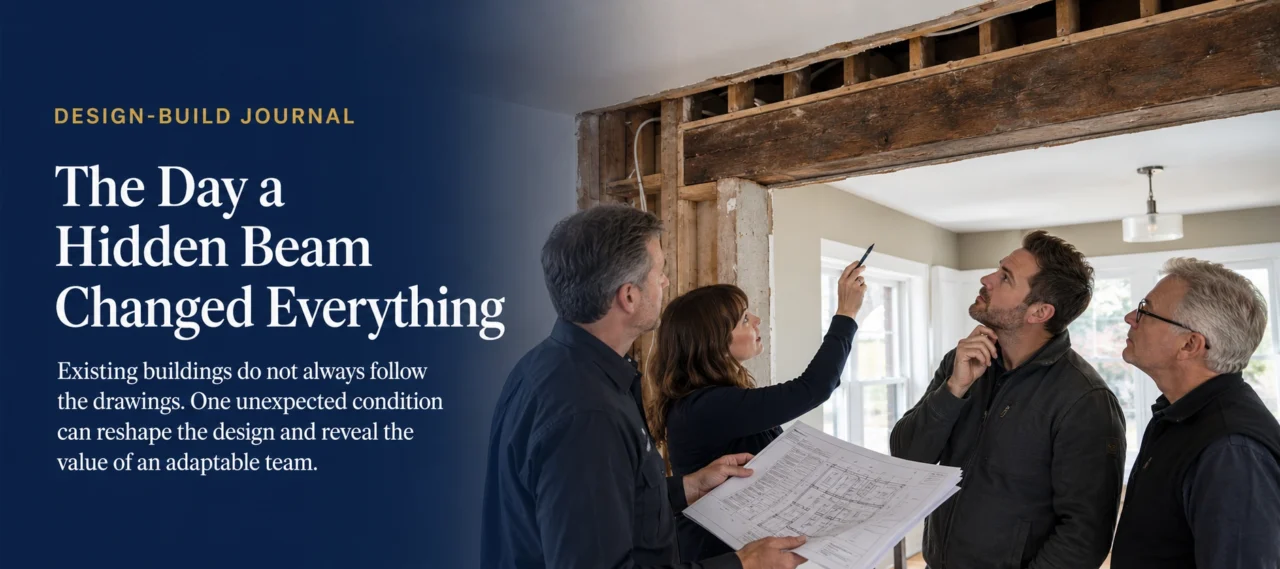
Construction then exposed something the finished home had concealed: a key roof-support beam had not been constructed as expected. The discovery changed the structural assumptions behind the design and required the team to reconsider how the opening would be supported. It was a reminder that existing buildings carry information no drawing, inspection, or conversation can always reveal completely.
What mattered next was not simply that an unexpected condition had been found. What mattered was how the project responded to it.
The Difference Between a Surprise and a Crisis
Unexpected conditions are sometimes described as though their discovery automatically signals a failure in planning. Existing-building projects are more complicated than that because walls, ceilings, floors, and finishes conceal decades of construction decisions.
Original drawings may be unavailable, incomplete, or inconsistent with what was actually built. Earlier owners may have made changes without preserving documentation, while materials and construction methods may differ from what their visible surroundings suggest. Thoughtful planning can reduce uncertainty, but it cannot make every concealed condition visible before construction begins.
The objective is therefore not to promise that surprises will never occur. It is to understand the building as thoroughly as practical, identify where uncertainty remains, and prepare the project team to respond without losing direction. That distinction can determine whether an unexpected discovery becomes a manageable project decision or a crisis.
The Beam Changed More Than the Structure
The hidden condition could not be addressed by considering structure alone. A revised support solution would affect the appearance of the opening, ceiling conditions, electrical routing, finish details, construction sequence, cost, and schedule.
The structural engineer and project team needed to understand how the roof loads were actually being carried and develop an appropriate response. The solution required a new laminated beam and reinforced posts capable of supporting the revised opening. Those structural elements then had to be integrated into the design, and their dimensions influenced how the opening would be perceived, how the posts would relate to the surrounding architecture, and how electrical and finish work would be coordinated.
The beam changed the project, but it did not change the project’s purpose. The goal remained to create a connected kitchen and living environment that felt natural within the home.
Understanding Creates a Framework for Response
This is where Managing Risk Through Understanding becomes practical rather than theoretical. Risk is not managed by pretending uncertainty does not exist. It is managed by developing enough understanding to recognize the significance of new information and make a coordinated decision when conditions change.
The team already understood the owner’s priorities, the desired relationship between the rooms, and the design intent behind the opening. The relevant professionals were therefore able to evaluate the structural condition together. Because those priorities and relationships had been established, the unexpected beam did not force the project to begin again without direction.
Instead, the team could ask focused questions. What structural solution would safely support the roof? How would the required beam and posts affect the architecture? Which systems and finishes would need to change? What consequences would each alternative have for cost and schedule? Understanding gave the team a basis for answering those questions and comparing the available responses.
Preconstruction Still Matters When Something Is Hidden
A concealed condition does not make preconstruction unnecessary. It demonstrates why preconstruction is essential. The work described in Preconstruction: Where Successful Projects Begin allows the team to investigate visible conditions, review available records, coordinate professional expertise, establish project priorities, and identify areas of uncertainty before construction.
That preparation cannot reveal everything hidden inside an existing building. It can, however, reduce the number of unsupported assumptions and ensure that the project has a coherent framework when new information appears.
Because the design, budget, technical requirements, and owner priorities have already been considered together, the team can evaluate a concealed condition in relation to the whole project. The response becomes an informed adjustment rather than an isolated field decision.
Communication Becomes Part of the Solution
Unexpected discoveries require clear communication because every participant needs to understand both the condition and its broader consequences. The owner needs to know what was found, why it matters, and what alternatives are available. The engineer must explain the structural requirements, while the builder evaluates constructability, sequencing, and field conditions. The designer must consider how the necessary solution can be integrated without weakening the intended experience.
This communication should neither minimize the condition nor make it appear more alarming than it is. Owners need enough information to understand the consequences and participate meaningfully in the decision.
When people share the same understanding, the conversation can move from “We found a problem” to “Here is what the condition means, and here is how we can respond.” That shift protects confidence even when the project encounters something no one could see beforehand.
Adaptation Does Not Mean Abandoning the Design
The revised beam and reinforced posts became necessary structural components, but necessity did not require them to feel disconnected from the finished home. With careful coordination, structural elements can participate in the architecture. Their placement, proportions, finish treatment, and relationship to surrounding features can make them feel deliberate rather than corrective.
This is one of the quiet disciplines of remodeling. The team is rarely working with complete freedom because it must respond to an existing building, including conditions that may challenge the original idea.
A successful adaptation respects technical reality without losing sight of the human purpose behind the project. The solution must support the building safely while continuing to serve the experience the owners intended to create.
What the Hidden Beam Taught Us
The discovery reinforced several lessons that apply to almost every existing-building project. Investigation matters because visible conditions provide clues about what may be concealed. Professional coordination matters because one unexpected condition can affect structure, design, systems, cost, and schedule simultaneously. Communication matters because owners deserve to understand both the problem and the reasoning behind the response.
Most importantly, planning matters because it gives the project a stable purpose even when the path must change. The hidden beam changed the structural solution, several construction details, and the work required to complete the opening. It did not prevent the project from achieving its larger goal.
A Final Thought
Existing buildings always retain some ability to surprise us. Experience does not eliminate that reality; it teaches us how to approach it. When a concealed condition is discovered, the strongest response begins with understanding rather than reaction.
The team investigates what has been found, brings the necessary knowledge together, explains the consequences clearly, and develops a solution that protects both the building and the owner’s priorities. The day the hidden beam changed everything did not become a story about a project losing its way. It became a story about why thoughtful planning, professional coordination, and calm adaptation matter.
Continue Exploring the Design-Build System
Concealed conditions become more manageable when a project has already established shared priorities and a coordinated framework for decision-making. Explore Managing Risk Through Understanding to see how informed preparation strengthens a project’s response to uncertainty. You can also examine Preconstruction: Where Successful Projects Begin or return to the complete Design-Build Foundation Guides.