
Beauty Rarely Happens by Accident
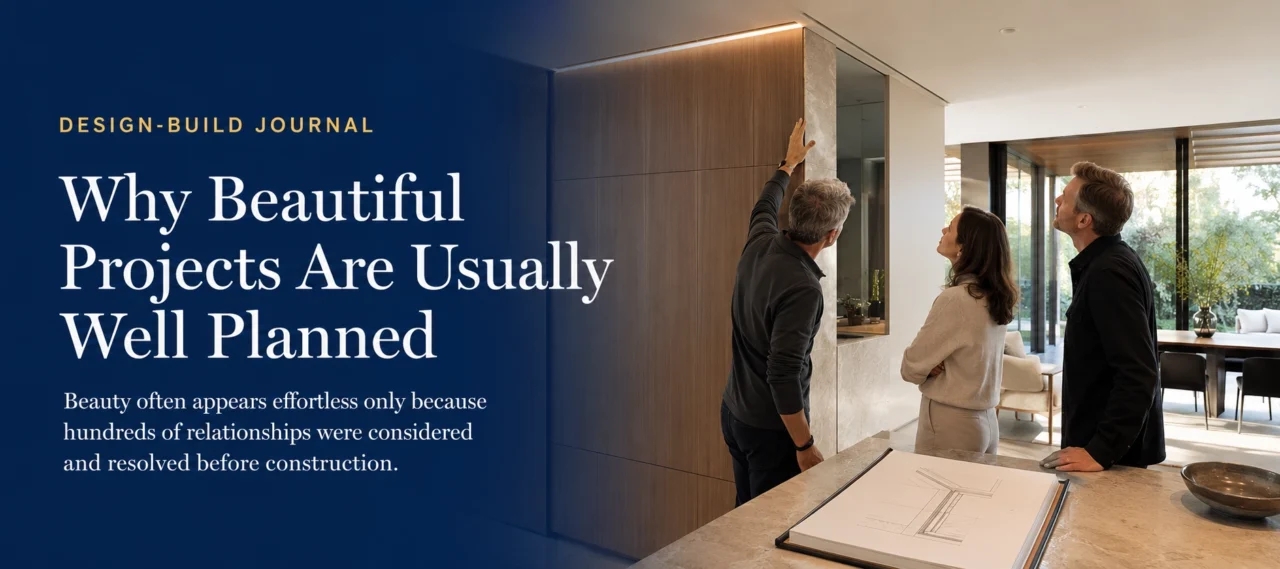
When people admire a completed project, they naturally notice what they can see. They respond to proportion, light, materials, craftsmanship, color, and the way the spaces relate to one another. What they cannot see is the planning that made those qualities possible.
Behind a simple ceiling detail may be weeks of coordination among structure, mechanical systems, lighting, and finish work. A clean transition between materials may depend upon decisions made before either material was ordered. A room that feels effortless may be the result of dozens of alternatives that were studied, questioned, adjusted, and refined.
Beautiful projects often appear simple when they are complete, but the work required to achieve that simplicity is usually anything but simple. The visible result is supported by a largely invisible process of understanding relationships and resolving them before construction makes them permanent.
Design Intent Must Survive Construction
A strong design begins with an idea about how the building should look, feel, and perform. That idea must then pass through budgeting, engineering, permitting, procurement, scheduling, and construction without losing its essential purpose.
This is where many projects struggle. Design decisions may be made without sufficient knowledge of how they will be built. Pricing may arrive after the design has already become difficult to change, while materials may be selected independently of their installation requirements, availability, or relationship to adjoining conditions.
As unresolved questions accumulate, the original design intent becomes vulnerable. Decisions are made under pressure, substitutions occur without considering their larger effects, and details are improvised in the field. The finished project may contain many attractive elements without feeling fully resolved because those elements were never coordinated as parts of one composition.
Planning protects the relationship between the original idea and its physical execution. It allows the project team to determine what the design requires before construction begins testing those decisions in the field.
The Details Depend on One Another
Beauty is often found in relationships rather than individual objects. The position of a window affects natural light, exterior composition, interior furniture placement, structural framing, and surrounding finishes. Cabinet proportions influence countertops, backsplashes, appliances, lighting, hardware, and circulation, while a ceiling treatment may depend upon framing depth, duct locations, sprinkler requirements, recessed lighting, and trim.
No single decision creates the finished result because every decision participates in a larger composition. When these relationships are considered early, details can support one another. Lines align, transitions feel intentional, and technical necessities become part of the architecture.
When those same decisions are addressed separately, even expensive materials can appear disconnected. A beautiful project is therefore not simply a collection of beautiful selections. It is a coordinated system of decisions in which each element strengthens the whole.
Preconstruction Protects the Design
This coordination is one of the central purposes of Preconstruction: Where Successful Projects Begin. During preconstruction, the team investigates existing conditions, develops the design, reviews structural and technical requirements, studies costs, and identifies the decisions needed before construction. Designers, builders, engineers, and trade professionals can examine how the parts of the project will come together while changes remain relatively flexible.
This work may reveal that a desired detail requires a different structural approach. It may identify a conflict between lighting and mechanical systems, show that a material needs to be ordered earlier than expected, or uncover a simpler and more economical way to accomplish the design intent.
Resolving these matters early does not restrict creativity. It gives creative ideas a realistic path into the finished building by ensuring that design intent, technical requirements, and construction methods develop together.
Good Planning Is Not the Elimination of Change
Planning is sometimes misunderstood as an attempt to predict every circumstance and prevent the project from evolving. That is not its purpose. Projects naturally develop as new information becomes available, existing buildings reveal concealed conditions, materials are viewed in person, and better ideas emerge through continued discussion and refinement.
Good planning creates a framework within which those changes can be evaluated. The team understands the project’s priorities, the relationships between decisions, and the consequences of changing direction. Adaptation can therefore occur without causing the project to lose its coherence.
Without that framework, change becomes reaction. With it, change remains part of thoughtful design because each revision can be measured against an established purpose.
The First Version Is Built Through Decisions
The Foundation Guide Every Building Is Created Twice explains that a project is first created through understanding, planning, drawings, specifications, and coordinated choices. It is then created a second time through physical construction.
The quality of that first creation influences everything that follows. When dimensions, materials, systems, and details have been considered together, the second creation becomes more predictable. Trade professionals can prepare their work around a coordinated plan instead of being required to resolve fundamental design questions as installation proceeds.
This does not make craftsmanship less important. It allows craftsmanship to be used where it creates the greatest value. Skilled people can concentrate on execution, refinement, and quality rather than spending their time compensating for missing information.
Restraint Requires Planning
Some of the most beautiful projects are distinguished not by how much was added, but by how carefully unnecessary elements were removed. Restraint is difficult because every visible feature competes for attention and resources. A material may be beautiful by itself but unnecessary within the larger composition, while a dramatic detail may weaken a room that would be stronger with a quieter response.
Additional complexity can make a design feel less resolved rather than more distinctive. Planning gives the team time to compare, simplify, and refine. It allows an early idea to mature instead of requiring the first concept to become the final answer.
What appears effortless at completion is often the result of disciplined editing. The project feels clear because the team invested time in deciding what genuinely belonged and what could be removed.
Beauty and Performance Belong Together
A project should not have to choose between being beautiful and working well. The strongest designs allow performance to contribute to beauty. Natural light can reduce dependence on artificial lighting while enriching the character of a room. Durable materials can age gracefully rather than merely survive wear, and well-organized circulation can make a space feel calm and generous.
Thoughtfully integrated storage can reduce visual clutter while improving everyday use. Appropriate acoustic treatment can make a workplace or gathering space feel more comfortable, while well-coordinated systems can preserve architectural clarity without compromising performance.
These qualities are easier to achieve when functional, technical, and aesthetic decisions are developed together. Beauty then becomes part of how the building performs rather than a finish applied after practical concerns have already been resolved.
A Final Thought
Beautiful projects are usually well planned because beauty depends upon relationships that must be understood before they can be built. The finished photograph may capture a room in a single moment, but it cannot show the conversations, investigations, comparisons, drawings, and coordinated decisions behind it.
Those quiet efforts are present nonetheless. They can be seen in the details that align, the materials that belong together, and the spaces that feel natural to use. Beauty may be what people notice first, but thoughtful planning is often what allows it to endure.
Continue Exploring the Design-Build System
The visible quality of a project is strengthened by the decisions resolved before construction begins. Explore Preconstruction: Where Successful Projects Begin to understand how early coordination protects design intent. You can also read Every Building Is Created Twice or return to the complete Design-Build Foundation Guides.