

Every Project Reaches a Point Where Decisions Become Commitments
There is a phrase we occasionally hear during the early stages of planning: “We’ll figure that out later.”
Sometimes it refers to a finish material. Sometimes it involves lighting, cabinetry, furniture placement, equipment requirements, or the exact location of an interior wall. The thought is understandable. With so many decisions to make, postponing a few of them can seem like a practical way to keep the project moving.
Occasionally, that approach works. More often, however, those four words quietly become some of the most expensive words spoken during an entire project. The reason has very little to do with the size of the decision itself. It has everything to do with timing.
Planning Preserves Flexibility
During planning, ideas remain remarkably flexible. Alternatives can be explored without interrupting construction, affecting trade schedules, delaying material orders, or requiring completed work to be revised.
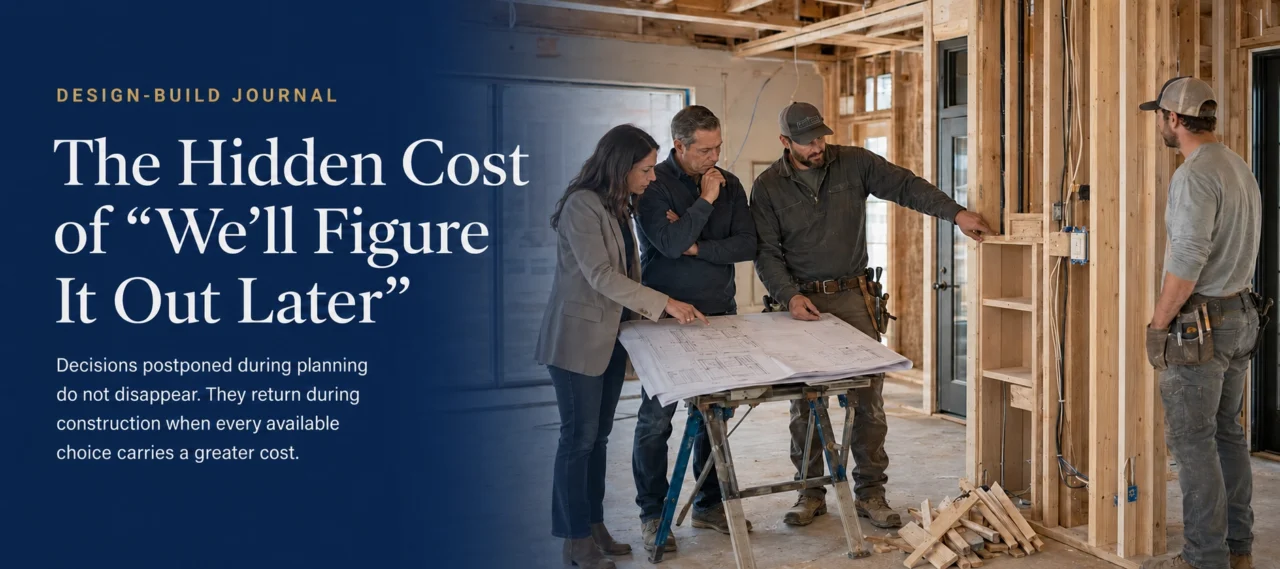
A conversation around a table may prevent days of work in the field because changing an idea on paper is far easier than changing framing, utilities, cabinetry, or finishes that have already been ordered or installed. At this stage, the project still has room to think.
This is one of the economic advantages of resolving questions during design and preconstruction. The cost of considering an alternative is relatively small while the project remains conceptual. A layout can be adjusted, a material can be compared with another option, and the consequences of a decision can be studied before it becomes a physical commitment.
As construction progresses, that freedom gradually disappears.
Decisions Do Not Remain Isolated
Every project decision is connected to other decisions. Framing influences mechanical systems, and mechanical systems affect electrical work. Cabinet layouts determine plumbing locations, lighting plans, appliance clearances, and finish details. Flooring choices can affect transitions, door clearances, cabinetry, and construction sequencing.
What once appeared to be an isolated question quietly becomes part of a much larger network of commitments. Revisiting it no longer means changing a single drawing. It may require revising several drawings, changing an order, rescheduling trades, removing completed work, and coordinating every condition affected by the change.
The Foundation Guide Construction Is the Result of Earlier Decisions explains why the work visible in the field cannot be separated from the decisions made before it began. Construction does not independently determine the project’s outcome. It executes an increasingly interconnected collection of earlier choices.
When an important choice remains unresolved, the surrounding work does not necessarily wait. Other decisions continue to be made, often based on assumptions about what the delayed answer will eventually be. The longer those assumptions remain unconfirmed, the more deeply they become embedded in the project.
Delayed Decisions Relocate Complexity
Looking back, we have found that delays rarely reduce complexity. More often, they relocate it.
Instead of investing time in thoughtful discussion while options remain open, the project eventually invests more time resolving conflicts under the pressure of active construction. The decision still has to be made, but it now carries greater consequences because design, procurement, scheduling, and physical work have continued moving forward.
A delayed lighting decision may require changes to completed electrical rough-in. An unresolved appliance selection may affect cabinetry, power, ventilation, plumbing, and delivery schedules. A late material choice may introduce an unexpected lead time that prevents an entire area from being completed.
The question did not disappear when it was postponed. It simply returned at a less flexible and more expensive point in the project.
The Financial Value of Earlier Clarity
Experienced Design-Build professionals encourage owners to invest time in important decisions before construction begins because planning is the stage where thoughtful exploration is both economical and productive.
This is central to The Economics of Better Planning. Better planning does not create value merely by reducing the number of changes. It allows decisions to be evaluated while the team can still compare alternatives, coordinate consequences, and direct resources toward the owner’s priorities.
Every decision that reaches clarity during planning strengthens the decisions that depend upon it. Drawings become more reliable, scopes become more complete, pricing becomes more meaningful, and trade partners can prepare their work with fewer assumptions.
The time invested early is not an additional burden placed on the project. It is part of the work required to make later execution more predictable.
Reflection Is Not the Same as Postponement
There is nothing wrong with taking time to make an important decision. Thoughtful decisions often require research, comparison, discussion, and careful reflection. The goal is not to pressure owners into making every choice quickly.
The hidden cost appears when reflection is confused with postponement. Reflection moves a decision toward clarity. Postponement leaves the question unresolved while other parts of the project continue developing around it.
A thoughtful planning process identifies which decisions must be made first, which can safely remain open, and what information the owner needs before making them. This sequencing respects the importance of each decision while protecting the project from unnecessary consequences.
A Final Thought
Successful projects are not built by making every decision quickly. They are built by making the right decisions while the project still has the freedom to benefit from them.
“We’ll figure it out later” can feel like a way to preserve flexibility, but important unresolved questions usually have the opposite effect. As the project advances, options narrow and consequences grow. Earlier clarity protects the freedom to explore, compare, and make decisions deliberately before construction turns them into commitments.
Continue Exploring the Design-Build System
Construction reflects the quality and timing of the decisions that precede it. Explore Construction Is the Result of Earlier Decisions to understand how planning choices shape work in the field. You can also examine The Economics of Better Planning or return to the complete Design-Build Foundation Guides.