
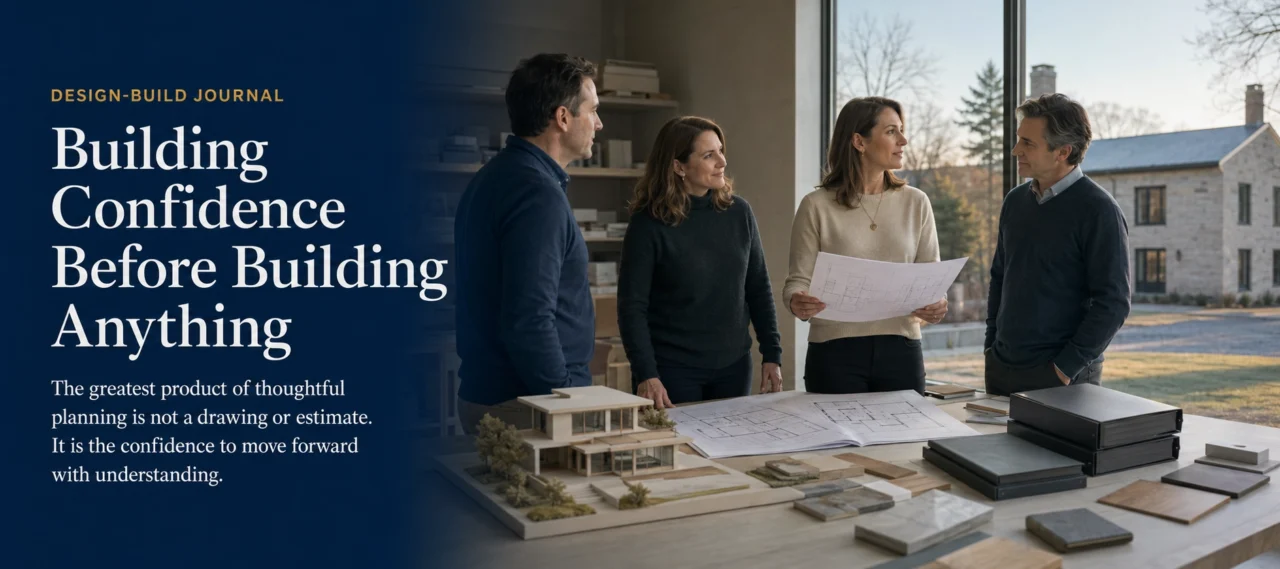
Confidence Is One of Planning’s Most Important Results
Before construction begins, owners are asked to make significant commitments. They approve designs, establish budgets, select materials, authorize engineering, agree to schedules, and prepare for the disruption that construction may bring. These decisions affect finances, property, operations, family life, and the way a completed building will serve people for years.
Owners do not need absolute certainty before moving forward. Construction will always contain some uncertainty, particularly when an existing building is involved. They do, however, need confidence.
That confidence does not come from being told that everything will work out. It develops through understanding what is being proposed, why it is recommended, what it will require, and how the team will respond when circumstances change.
Confidence Is Different From Excitement
Most projects begin with excitement. Owners imagine a more functional home, a better workplace, or a building that supports the next stage of their lives or organization. Images, sketches, and early possibilities create momentum.
Excitement is valuable, but it cannot carry the full weight of a construction decision. As the project becomes more real, practical questions emerge. Can the design be built within the available resources? What conditions remain unknown? How were the costs developed? Which selections are complete? What responsibilities belong to the owner, and which belong to the project team?
Confidence begins when the project can answer these questions clearly enough for enthusiasm and responsibility to coexist.
Drawings Alone Do Not Create Confidence
A well-developed drawing can help owners see what the project may become. It communicates spatial relationships, dimensions, materials, and design intent, but drawings represent only one part of the decision.
Owners also need to understand how the design responds to existing conditions, what engineering it requires, how it relates to the budget, which materials have been selected, and how construction will be sequenced.
A beautiful design accompanied by incomplete pricing, unresolved technical questions, or uncertain selections may create inspiration without confidence. The owner can see the destination but does not yet understand the path. Confidence grows when design, construction knowledge, and financial information develop together.
A Budget Must Be Understandable
A number does not create confidence merely because it is precise. Owners need to know what the budget includes, which assumptions support it, what remains excluded, where allowances are being used, and which unresolved decisions could change it. They should understand how the proposed investment relates to the project’s priorities and where alternatives may exist.
No responsible project team can guarantee that an existing-building project will never encounter an unexpected cost. It can explain how the budget was developed, identify known areas of uncertainty, and avoid presenting incomplete information as certainty.
An understandable budget allows an owner to make a financial commitment with greater awareness rather than relying on the hope that unanswered questions will resolve themselves favorably.
Decisions Create Confidence Gradually
Project confidence is not produced in one meeting. It accumulates as important questions are resolved. The purpose becomes clearer, existing conditions are investigated, design alternatives are considered, and technical requirements are coordinated. Materials are selected, pricing becomes more complete, and the schedule begins reflecting actual project decisions rather than general expectations.
Each resolved question provides a stronger foundation for the next one. This is why a thoughtful process should not pressure owners to feel confident before enough work has been completed. Confidence should be earned through the steady development of the project.
Understanding Makes Risk Manageable
One of the greatest obstacles to confidence is uncertainty. Owners may worry about concealed conditions, changing costs, schedule disruption, or decisions they do not yet feel prepared to make. These concerns are reasonable and should not be dismissed.
The Foundation Guide Managing Risk Through Understanding explains that risk becomes more manageable when it is made visible. The team identifies what is known, what remains uncertain, what consequences may follow, and what actions can reduce exposure.
This does not eliminate risk. It replaces undefined anxiety with specific questions the project can investigate, discuss, or prepare for. Owners do not need to believe that nothing unexpected will happen. They need confidence that the team understands the project well enough to respond thoughtfully if it does.
Preconstruction Builds the Path Forward
Preconstruction: Where Successful Projects Begin describes the stage in which confidence is developed most deliberately.
During preconstruction, the project team studies the building, develops the design, coordinates professional knowledge, evaluates constructability, prepares pricing, reviews selections, and considers permitting, procurement, and scheduling. These activities are not separate administrative exercises. Together, they answer the owner’s central question: Are we prepared to build this project responsibly?
When preconstruction is complete, the owner should understand the project’s purpose, scope, design, financial framework, known risks, and path into construction. Remaining uncertainties should be recognized rather than concealed. The goal is not perfect knowledge. It is sufficient understanding to make a responsible commitment.
Communication Protects Confidence
Confidence established before construction must be maintained while the work proceeds. Owners need regular information about progress, upcoming decisions, schedule developments, and unexpected conditions. They need to know when something has changed and understand what the change means.
Silence allows uncertainty to return. Clear communication keeps the owner connected to the project’s reasoning. This does not mean communicating every field detail or technical conversation. It means providing relevant information before the owner is surprised by its consequences.
Trust grows when communication remains consistent during both ordinary progress and difficult moments.
Confidence Improves Decisions
Owners make better decisions when they understand the project and trust the process guiding it. They are less likely to respond to every new question as an isolated crisis. They can evaluate alternatives in relation to established priorities and understand why some decisions require time while others must be completed promptly.
Confidence does not remove emotion from construction. The investment and disruption remain personal. It provides a framework that helps owners navigate those emotions without losing sight of the project’s larger purpose.
A confident owner is not one who never asks questions. It is one who knows that questions are expected and will be addressed through a reliable process.
Confidence Benefits the Entire Team
Owner confidence also strengthens the work of designers, builders, engineers, and trade professionals. When priorities have been clearly established and decisions are documented, the team can move forward with greater alignment. People understand what they are building and why particular requirements matter.
This does not prevent debate or revision. It gives those conversations a shared point of reference. A project team performs more effectively when it is not repeatedly reconstructing decisions that should have been settled earlier. Confidence provides continuity from planning into construction.
The Greatest Product of Planning
Drawings, budgets, specifications, selections, and schedules are necessary products of project planning. They provide the information required to price, permit, coordinate, and construct the work. Yet their larger purpose is to create understanding.
When those documents and decisions agree, owners can see not only what will be built but also how the project has been considered. They can recognize the relationships between priorities, design, cost, risk, and execution.
That understanding produces something no individual document can provide by itself: confidence to proceed.
A Final Thought
Building confidence before building anything does not mean waiting until every uncertainty has disappeared. That moment does not exist. It means developing the project thoroughly enough that owners understand what they are committing to, why the proposed direction makes sense, which risks remain, and how the team is prepared to manage them.
Construction should not begin simply because the drawings are finished or a target date has arrived. It should begin when planning has created a responsible foundation for action.
The first thing a thoughtful Design-Build process constructs is not the building. It is the confidence required to build it well.
Continue Exploring the Design-Build System
Owner confidence grows when uncertainty is identified, decisions are coordinated, and the path into construction is clearly understood. Explore Managing Risk Through Understanding to see how clarity makes uncertainty more manageable. You can also examine Preconstruction: Where Successful Projects Begin or return to the complete Design-Build Foundation Guides.