
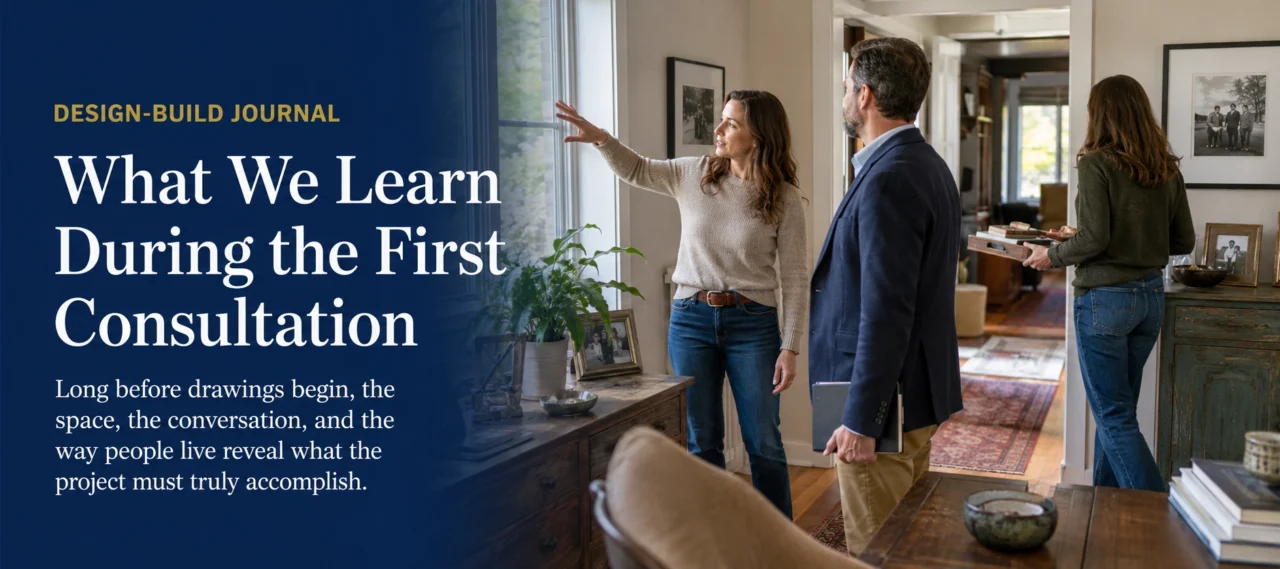
The First Meeting Is About More Than the Project
A first consultation may seem like a conversation about rooms, walls, budgets, and construction possibilities. Those subjects matter, but they are not the only things we are trying to understand. We are also learning how the owners think about the building, what prompted them to consider a project, which concerns they have carried quietly, and what they hope will feel different when the work is complete.
The first meeting is not the time to arrive with a predetermined solution. It is the beginning of a shared effort to understand whether the right project—and the right working relationship—can be developed.
We Learn What the Owners Appreciate
One of the most important things we learn is what already works. Owners may want significant change while still valuing the building’s character, natural light, neighborhood relationship, familiar gathering places, or materials that have aged well. A business may need a new layout while wanting to preserve the qualities that customers and employees already associate with the organization.
These positive observations matter because a project should not treat everything existing as a problem. Understanding what the owners appreciate helps the design distinguish between conditions that should be transformed and qualities that deserve protection. It also reveals something about the owners’ values. What they choose to preserve can be as informative as what they hope to change.
We Learn Why the Project Matters Now
Most projects have a moment that brings them forward. A growing family may have reached the limits of the existing layout. Adult children and grandchildren may have changed how the home is used. Aging may have made accessibility and comfort more important. A business may be expanding, reorganizing, welcoming customers differently, or adapting to new ways of working.
The physical request is often connected to a larger change in life or work. Understanding why the project matters now helps the team recognize its urgency, emotional significance, and long-term purpose. It also helps distinguish a temporary frustration from a need the project should address for many years.
We Learn How the Building Is Actually Used
Buildings frequently function differently from the way their plans suggest. A formal dining room may have become a work area. A large living room may remain mostly unused while everyone gathers in a smaller kitchen. Employees may hold informal meetings in circulation areas because the designated meeting rooms do not support quick collaboration.
During the consultation, we pay attention to these patterns. We listen to how people describe their routines and observe how spaces connect, where belongings accumulate, and which areas naturally attract activity. These details reveal opportunities that measurements alone cannot provide. They show where the building supports everyday life and where people have created workarounds because it does not.
We Learn the Question Behind the Request
Owners usually enter the conversation with an idea of what they want. They may ask about removing a wall, enlarging a kitchen, adding space, relocating a bathroom, or reorganizing a workplace. The request gives us a starting point, but we also want to understand the need behind it.
The homeowner asking for an open plan may be seeking greater family connection. The owner considering an addition may need flexibility for several generations. A business requesting more offices may actually be struggling with privacy, sound, or communication.
Once the underlying need becomes clear, the team can evaluate whether the proposed solution is the best response or whether another approach may accomplish the goal more effectively.
We Learn About Priorities
Early conversations often reveal several competing goals. Owners may want more space, better light, improved storage, greater connection, higher-quality materials, less maintenance, increased accessibility, and minimal disruption. Few projects can maximize every priority equally.
The first consultation begins the process of determining what matters most. Which changes would make the greatest difference? Which features are essential? Where might flexibility exist? What would cause the project to feel unsuccessful even if everything else were completed well?
These questions do not force immediate decisions. They begin organizing the project around a hierarchy that later design and budgeting can use.
We Learn How Owners Make Decisions
Every owner approaches decisions differently. Some want to compare several alternatives before selecting a direction. Others prefer a focused recommendation supported by clear reasoning. Some understand ideas best through drawings, while others respond more naturally to photographs, material samples, or walking through the existing space.
The consultation helps the project team understand how information should be presented and how much explanation the owners need to feel confident. This is important because a Design-Build project contains many decisions. The process should not merely produce answers. It should help owners understand those answers well enough to participate meaningfully.
We Begin to Understand the Financial Framework
Budget is part of the first consultation, but it is most useful when connected to purpose and priorities. Before discussing what a project might cost, we need to understand what the investment is intended to accomplish. A preliminary number without an understood scope can create either false confidence or unnecessary discouragement.
The first financial conversation therefore explores expectations, priorities, and the level of project being considered. It helps determine whether the desired scope and available resources appear reasonably aligned and where further investigation will be required.
Budget clarity develops gradually as the design, existing conditions, materials, and technical requirements become better understood. The first consultation establishes the framework for that development.
We Learn About the Building
The consultation also begins our investigation of the existing building. We look at its general age, construction, additions, previous renovations, structural clues, utility locations, circulation, and relationship to the property. We note conditions that may influence the project and questions that cannot be answered through observation alone.
This initial review is not a complete inspection or technical investigation. Its purpose is to identify opportunities, constraints, and areas requiring further study. The building becomes another participant in the conversation. Its structure, history, and existing systems will help shape what the project can become.
We Learn Whether Design-Build Fits the Project
The Foundation Guide What Is Design-Build? explains how planning, design, budgeting, and construction can be brought together within one coordinated process.
The first consultation helps determine whether that approach fits the owner and the project. Does the work require significant coordination among design, engineering, estimating, selections, permitting, and construction? Does the owner value an integrated team and a guided decision-making process? Are the project’s goals and expectations compatible with the way the team works?
The meeting allows the owner to evaluate the Design-Build team and the team to evaluate whether it can serve the owner and project responsibly. Both sides need to determine whether their communication, expectations, values, and working styles provide a sound foundation for trust.
The First Consultation Begins the Design
No drawings may be produced during the first meeting, but design has already begun. The conversation identifies problems, establishes priorities, reveals constraints, and introduces possibilities. These are the raw materials of design.
As described in Design Is Decision Making, the project will develop through a sequence of choices about purpose, space, systems, materials, cost, and performance. The first consultation helps establish the standards those decisions will eventually need to serve.
A good first meeting therefore does not need to end with a finished idea. It should end with a clearer understanding of the questions the project must answer.
A Final Thought
What we learn during the first consultation extends far beyond the requested scope of work. We begin to understand the people, the building, the reason the project matters, the priorities that should guide it, and the questions requiring further investigation. The owners begin learning how the team listens, communicates, and approaches decisions.
The most productive first meetings do not create pressure to move quickly. They create enough shared understanding to determine whether moving forward together makes sense. That is a far more valuable beginning than an immediate answer.
Continue Exploring the Design-Build System
The first consultation begins integrating owner priorities, design thinking, financial considerations, and construction knowledge. Explore What Is Design-Build? to understand the framework that carries this early understanding forward. You can also examine Design Is Decision Making or return to the complete Design-Build Foundation Guides.