

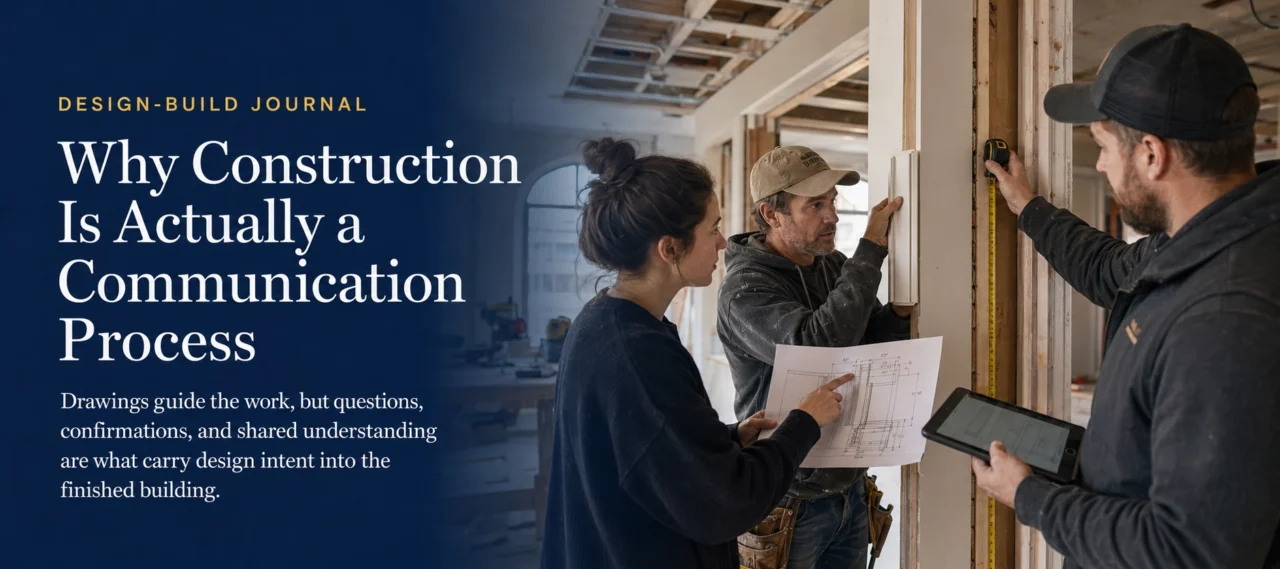
Buildings Are Created Through Instructions
Construction is usually described as physical work. Foundations are placed, walls are framed, utilities are installed, finishes are applied, and materials gradually come together into a completed building. What is less visible is the communication required before any of that work can happen correctly.
Every person working on a project needs to understand what is intended, what has already been decided, how their work relates to the work surrounding it, and when it must be performed. That understanding is communicated through conversations, drawings, specifications, scopes of work, selections, estimates, schedules, photographs, site meetings, and field observations. The finished building may be physical, but the process that creates it is built upon information moving accurately between people.
A Drawing Must Communicate Intent
Drawings are among the project’s most important communication tools. They describe dimensions, relationships, materials, assemblies, and details that cannot be conveyed reliably through conversation alone. Yet a drawing is useful only when it clearly communicates what the project team intends.
A floor plan may show the location of a wall but leave unanswered how that wall interacts with structure, utilities, finishes, cabinetry, or adjoining conditions. An elevation may communicate appearance without fully resolving how materials meet, while a technically correct note may still be misunderstood by someone reading it from a different professional perspective.
Strong construction documents do more than record decisions. They organize those decisions so that the people responsible for executing them can understand the same project and recognize how their work contributes to the intended result.
Selections Are Also Instructions
Owners often experience material and fixture selections as aesthetic choices. To the construction team, each selection is also a set of instructions. A plumbing fixture establishes rough-in requirements, clearances, mounting conditions, and connection details. An appliance affects cabinetry, electrical service, plumbing, ventilation, and delivery planning, while tile dimensions influence layout, substrate preparation, transitions, quantities, and installation time.
Even paint, hardware, and decorative lighting require accurate information about product, color, finish, location, quantity, and timing. When selections remain incomplete or are communicated informally, assumptions fill the gaps. One person may remember a conversation differently from another, a model number may change without every affected party being informed, or a substitute may appear equivalent while carrying different installation requirements.
Documented selections allow design decisions to become dependable construction instructions. They give each person responsible for procurement, preparation, and installation a consistent source of information.
The Schedule Communicates Relationships
A construction schedule is more than a list of dates. It communicates how the work of many people depends upon one another. Framing must reach an appropriate stage before certain mechanical and electrical work can proceed, and inspections may be required before walls are closed. Cabinet installation may depend upon field measurements, approved drawings, manufacturing time, delivery, and completed flooring or wall conditions.
When one activity changes, the schedule must communicate the effect on the activities that follow. A delay in one material can influence several trade partners, while a revised design decision can affect procurement, fabrication, installation, and inspection.
Effective scheduling therefore requires continuous communication. The schedule is not created once and followed mechanically. It must be maintained as the project develops, conditions change, and new information becomes available.
Coordination Prevents Separate Conversations
In fragmented project-delivery systems, information may travel through several disconnected paths. The owner communicates with the designer, the designer communicates with consultants, and construction professionals may become involved only after many decisions have already been made.
Each transfer creates an opportunity for context to be lost. The person receiving the information may know what was decided without understanding why it was decided. Questions may also travel back through several people before reaching someone with the knowledge and authority to answer them.
The Design-Build Process reduces these gaps by bringing owners, designers, builders, engineers, and trade knowledge into a coordinated process. Information can be evaluated by the people affected while decisions are still developing. This does not eliminate the need for documentation or clear responsibility; it makes those tools more effective because the people using them have helped develop a shared understanding of the project.
Field Conversations Matter
Even the most carefully prepared project requires communication during construction. Existing conditions become more visible, dimensions must be confirmed, and materials arrive with specific characteristics. Questions emerge as drawings meet physical reality, while trade professionals may identify an opportunity for improvement or a conflict that was not apparent earlier.
A good field question is not an interruption to construction. It is part of quality control. The important issue is how that question is handled. The team must identify who has the authority and knowledge to answer it, determine which other decisions may be affected, document the direction, and communicate it to everyone whose work depends upon the answer.
An undocumented field conversation can disappear as soon as the people involved leave the room. A properly communicated decision becomes part of the project record and provides reliable direction for the work that follows.
Communication Includes Listening
Construction communication is sometimes treated as the delivery of instructions from one person to another. The strongest teams understand that communication also requires listening because each participant brings knowledge others may not possess.
Trade professionals contribute practical experience developed through years of installation and fieldwork. Owners understand their priorities and how they expect to use the completed building. Designers protect the relationships and intent behind the project, while builders understand sequencing, constructability, and coordination. Engineers contribute specialized technical analysis that informs the safety and performance of the work.
Each participant may recognize something others cannot see from the same perspective. Listening allows that knowledge to improve the project rather than remain isolated. The objective is not to remove responsibility or allow every decision to become a group debate. It is to ensure that relevant knowledge reaches the decision before the work makes that decision difficult to change.
Construction Reveals the Quality of Earlier Communication
The Foundation Guide Construction Is the Result of Earlier Decisions explains that the work performed in the field reflects the clarity of the decisions made beforehand. Those decisions must be communicated accurately before they can become construction.
A carefully considered design provides little value if the builder does not receive complete information. A material selection cannot shape the project if its installation requirements are overlooked, and an owner’s priority cannot guide a field decision if the people making it do not understand why that priority matters.
Construction quality therefore depends upon more than individual skill. It also depends upon whether skilled people receive accurate, timely, and coordinated direction that allows their work to contribute to the same intended result.
Communication Protects Trust
Owners experience construction through communication as much as through visible progress. They need to understand what is happening, which decisions are approaching, how the schedule is developing, and how unexpected conditions are being addressed. Silence allows uncertainty to grow even when the physical work is proceeding properly.
Clear communication does not mean overwhelming owners with every technical detail. It means providing the information they need at the time they can use it. It also requires being direct about challenges, explaining their consequences, and presenting a thoughtful path forward.
Trust is strengthened when communication remains steady during both routine progress and difficult moments. Owners gain confidence when they know they will not learn about an important development only after its consequences have reached them.
A Final Thought
Construction is a communication process because every physical result begins as information that must be understood by another person. Drawings communicate relationships, specifications communicate expectations, selections communicate requirements, and schedules communicate sequence. Conversations communicate context, while field documentation preserves decisions as the work advances.
When these forms of communication agree, the project becomes more coordinated and predictable. When they conflict or remain incomplete, construction is forced to interpret what planning left unresolved. The building is the visible result, but communication is the largely invisible process that allows people to create it together.
Continue Exploring the Design-Build System
Construction becomes more reliable when owners, designers, builders, engineers, and trade professionals work from a shared understanding. Explore The Design-Build Process to see how communication is maintained from early planning through execution. You can also examine Construction Is the Result of Earlier Decisions or return to the complete Design-Build Foundation Guides.