
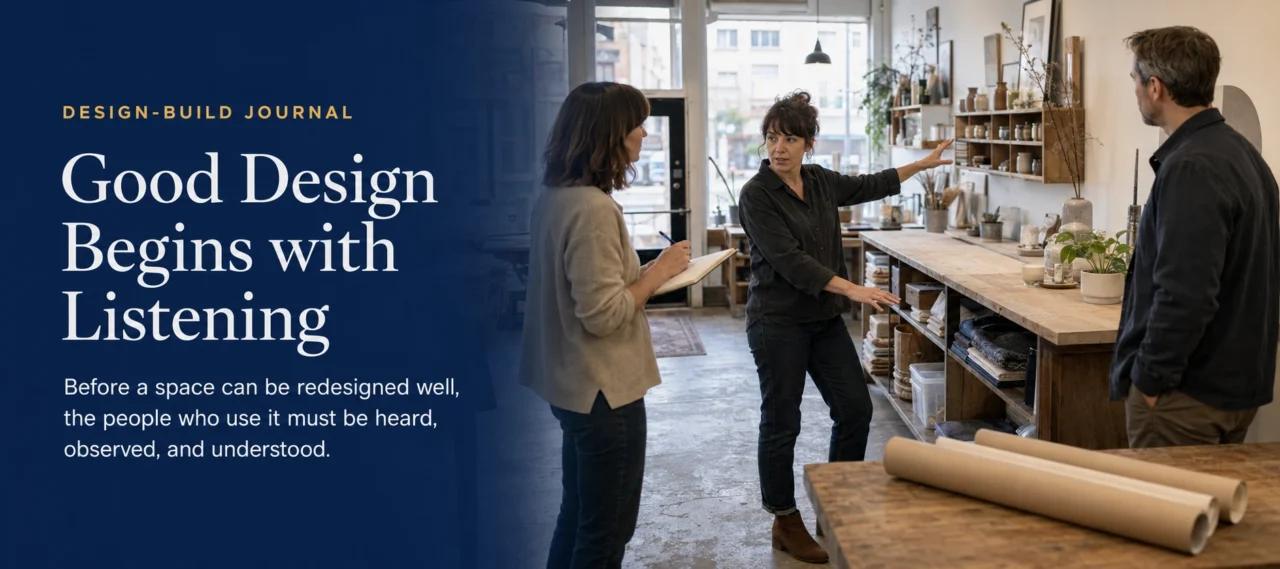
The Best Ideas Rarely Arrive First
People often imagine that good design begins with inspiration. They picture a designer sketching an exciting floor plan, selecting beautiful materials, or proposing a creative solution that transforms an ordinary building into something extraordinary.
Those moments certainly exist, and they are part of what makes design rewarding. They are not, however, where the best projects begin. More often, successful design begins with someone listening carefully enough to understand a problem that has not yet been fully expressed.
The Request Is Not Always the Need
A homeowner may say the family needs a larger kitchen, yet the deeper desire may be to prepare meals without feeling separated from family and friends. A business owner may ask for additional offices while the underlying challenge involves communication between departments. Another owner may believe more square footage is necessary, only to discover that a more thoughtful use of the existing space accomplishes the same objective.
These initial requests matter because they provide a place to begin. They should not automatically be treated as the final definition of the project.
Until the underlying need is understood, even the most creative design solution risks solving the wrong problem. A larger kitchen may still feel disconnected. Additional offices may further isolate a team. More square footage may add cost without improving how the building actually functions.
Listening allows the project team to distinguish between the solution initially requested and the outcome the owner genuinely hopes to achieve.
Questions Before Recommendations
Experienced Design-Build professionals spend considerable time asking questions before offering recommendations. They want to understand how people live, how they work, what frustrates them, and what they hope will be different after the project is complete.
What happens in the space on an ordinary day? Where do people naturally gather? Which activities compete with one another? What currently works well enough to preserve? What difficulties have become so familiar that the owner no longer thinks to mention them?
These questions do not delay design. They establish the basis for it.
The broader principles described in What Is Design-Build? begin with this integration of understanding and expertise. Designers, builders, and owners develop the project together so that proposed solutions reflect human priorities, construction realities, and financial considerations from the beginning.
Observation Reveals What Words May Miss
Listening involves more than hearing what someone says. People do not always have the vocabulary needed to describe spatial, functional, or technical problems. They may know that a room feels uncomfortable without understanding why, or recognize that a workplace is inefficient without being able to identify the source of the difficulty.
Observation can reveal what words leave unexplained. A project team may notice how a family naturally gathers in one part of the home while another room remains unused. It may observe how sunlight moves through the interior, where circulation paths cross, or where people hesitate as they move through the building. In a workplace, the team may see employees creating informal meeting areas because the planned spaces do not support the way collaboration actually occurs.
These patterns provide valuable design information. They reveal the difference between how a building was intended to function and how people genuinely experience it.
Curiosity Creates Better Possibilities
Curiosity plays an equally important role. Experienced professionals resist the assumption that they already understand the project after the first conversation. Every answer invites another thoughtful question, and every observation encourages a deeper examination of how the building serves the people who use it.
An apparent limitation may become an opportunity when viewed differently, while an appealing early idea may prove less valuable once its consequences are understood. This process is not about collecting information for its own sake. It is about developing the insight needed to make decisions that genuinely improve the owner’s experience.
That relationship between understanding and choice is central to Design Is Decision Making. Design advances through a sequence of decisions about priorities, relationships, constraints, materials, systems, cost, and performance. Listening gives those decisions a meaningful standard against which they can be evaluated.
Creativity Needs Direction
Creativity is most valuable when it responds to something real. Without a clearly understood purpose, design can become an exercise in producing impressive ideas rather than useful ones.
A visually striking solution may attract attention but fail to support everyday life. An innovative feature may consume resources that could have addressed a more important priority. A familiar design response may be applied simply because it worked elsewhere, even though the people and circumstances are different.
Listening gives creativity direction. It helps the team determine which possibilities deserve development and which, however attractive, do not serve the project’s central purpose.
Once that understanding develops, good ideas often emerge more naturally. They are no longer arbitrary proposals searching for approval. They become thoughtful responses to needs the owner and project team now understand together.
The Conversation Becomes Part of the Building
Looking back, we have found that the strongest designs rarely begin with the most impressive idea in the room. They begin with a conversation that uncovers something important about the people behind the project.
A question about family gatherings may eventually influence the relationship between a kitchen and living area. An observation about how employees communicate may shape the organization of an entire workplace. A discussion about aging, accessibility, or future flexibility may affect circulation, lighting, storage, and material selections throughout a building.
By the time construction is complete, those early conversations are no longer visible. Their influence, however, can be experienced in how naturally the building supports the people who use it.
A Final Thought
Listening is often viewed as the quiet part of design—the preliminary work completed before creativity begins. We have come to see it differently. Listening is part of the creative work.
Every thoughtful question, careful observation, and moment spent understanding another person’s goals becomes part of the design itself. The buildings people admire years later are often the visible result of conversations that took place long before the first line was drawn.
Continue Exploring the Design-Build System
Good design develops when clearly understood needs guide a coordinated series of choices. Explore Design Is Decision Making to see how purpose gives direction to every later project decision. You can also begin with What Is Design-Build? or return to the complete Design-Build Foundation Guides.