
Good Conversations Move Projects Forward
Construction projects involve countless conversations. There are meetings to discuss design, review budgets, coordinate engineering, evaluate existing conditions, select materials, and prepare for construction. Calendars quickly fill with appointments, site visits, conference calls, and planning sessions.
It would be easy to conclude that successful projects simply require more meetings than unsuccessful ones. Our experience has taught us something different: the quality of the conversation matters far more than the number of times people gather.
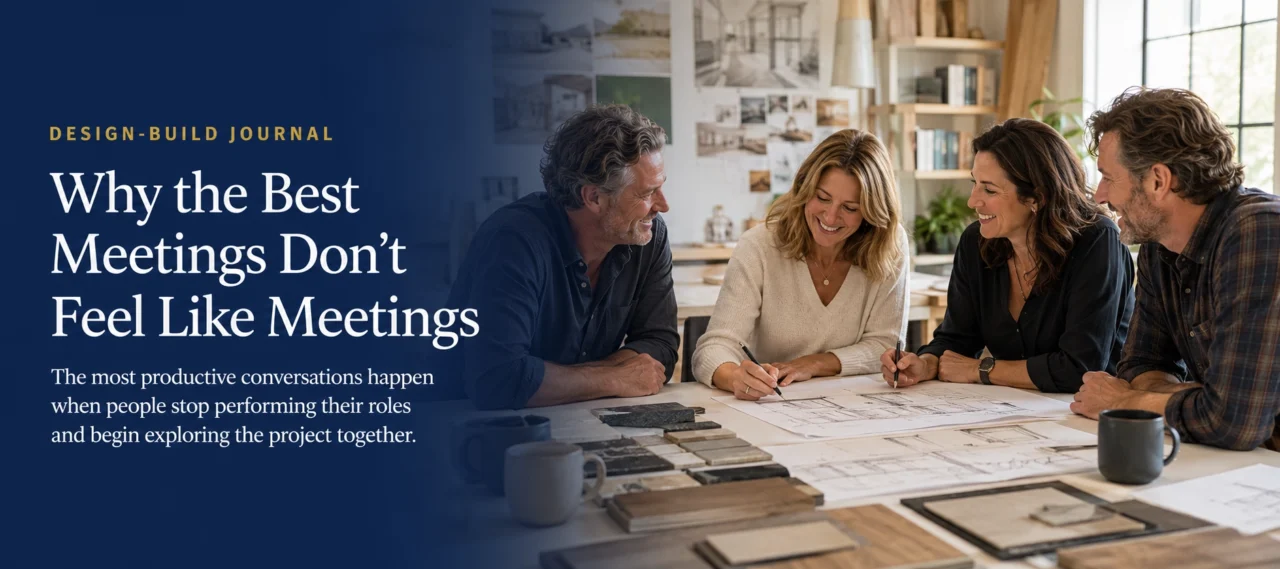
The most productive meetings are rarely remembered as meetings at all. They become genuine conversations among people working together to understand and solve a common problem.
From Exchanging Information to Building Understanding
Traditional meetings often revolve around distributing information. Someone presents an idea, others respond, notes are recorded, and assignments are made. That structure may be necessary, but exchanging information alone does not guarantee that everyone understands the project in the same way.
Information can be emailed, printed, or presented on a screen. Understanding develops differently. It grows as people ask thoughtful questions, examine assumptions, and connect ideas that initially seemed unrelated.
In the best project conversations, people ask questions without feeling hurried. Different perspectives are explored without becoming arguments, and ideas are examined from several directions before anyone feels pressured to reach a conclusion. By the time the conversation ends, everyone leaves with a clearer understanding than they had when it began.
That clarity is far more valuable than the meeting itself.
Different Perspectives Around One Table
The strongest projects often reach important decisions naturally because the people involved invest time in understanding one another before trying to persuade one another.
Owners explain how they hope to live, work, or serve others within the completed building. Designers identify possibilities the owners may not have considered. Builders contribute practical knowledge drawn from work in the field. Engineers help the team understand the structural and technical consequences of different approaches. Trade professionals contribute specialized knowledge about systems, materials, installation, and long-term performance.
Each participant sees the project through a different lens. Those perspectives can create confusion when they remain separated, but they become extraordinarily valuable when brought into one coordinated conversation.
This collaboration is central to The Design-Build Process. Design-Build does more than place several disciplines under one organizational structure. It creates opportunities for their knowledge to influence the project while decisions are still being developed.
A Good Meeting Has a Purpose
A productive meeting does not require formality, but it does require purpose. The people involved should understand what needs to be discussed, what information is available, and which decisions the project is prepared to make.
Some conversations are exploratory. Their purpose is to uncover possibilities, surface concerns, or identify questions requiring further investigation. Other meetings are evaluative, allowing the team to compare alternatives against the project’s priorities, budget, and technical constraints. Still others are intended to confirm a direction so that design, pricing, procurement, or construction can move forward.
Confusion develops when these purposes are mixed together. An owner may believe the team is still exploring while a designer believes a decision has been finalized. A builder may price an option that the owner considered only a preliminary idea. A clearly understood purpose prevents the conversation from producing false expectations.
The meeting should move the project toward greater understanding, even when it does not produce an immediate decision.
Conversation as Part of Design
We sometimes think of design as something that occurs primarily through drawings. In reality, much of the most important design work takes place through conversation.
The Foundation Guide Design Is Decision Making explains that design develops as priorities, constraints, and alternatives are understood and resolved. Conversation is how much of that understanding is created.
A homeowner’s observation about how the family gathers may alter the layout. A builder’s question may reveal a construction consequence that changes the preferred approach. An engineer’s explanation may transform what appeared to be a limitation into a new design opportunity. These contributions become part of the project long before they appear on a drawing.
The most valuable conversations are often those in which no single participant dominates. Everyone contributes to a deeper understanding, and the resulting decision becomes stronger because it reflects knowledge that no individual possessed alone.
Clarity Accumulates Over Time
Projects rarely succeed because someone had all the answers in the first meeting. They succeed because each conversation builds upon the one before it. Questions become clearer, priorities become more defined, assumptions are tested against new information, and decisions become easier because everyone understands the purpose those decisions are intended to serve.
This accumulated clarity is one of the quiet strengths of an integrated project team. The team does not repeatedly restart the conversation as information moves from owner to designer, designer to engineer, and designer to builder. Knowledge remains connected, allowing each discussion to advance the work already completed.
The meeting itself may soon fade from memory, but the clarity it created continues guiding the project long afterward.
A Final Thought
Some of the most important work in a Design-Build project takes place before anyone picks up a pencil or a hammer. It happens when people with different experience gather around the same table, listen carefully, and begin seeing the project through one another’s eyes.
Those conversations rarely feel like meetings. They feel like progress. In many ways, they are where successful projects truly begin.
Continue Exploring the Design-Build System
Productive conversations allow the knowledge of owners, designers, builders, engineers, and trade professionals to shape the project together. Explore The Design-Build Process to understand how that collaboration continues from early planning through construction. You can also examine Design Is Decision Making or return to the complete Design-Build Foundation Guides.