

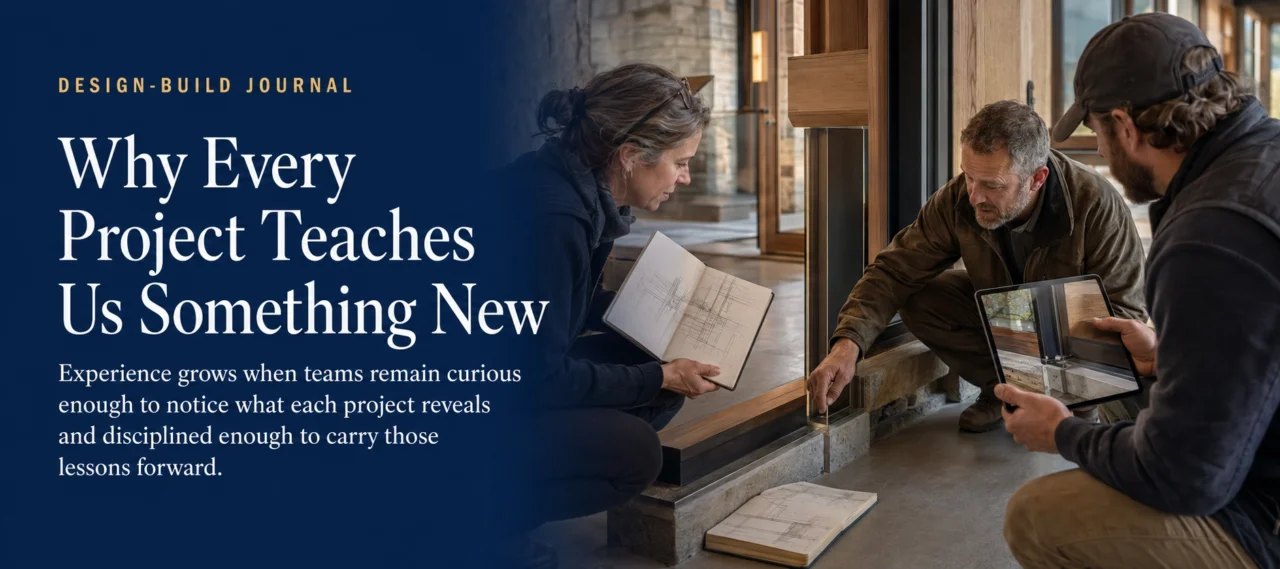
Experience Does Not Make Projects Identical
After many years in construction, certain patterns become familiar. We learn which questions should be asked early, where existing buildings often conceal uncertainty, how decisions affect one another, and which details require especially careful coordination. Experience helps us recognize conditions that might otherwise be overlooked and respond more calmly when something unexpected occurs.
Yet experience never makes two projects identical. Every building has a different history, and every owner brings different priorities. Every site, design, team, material, and set of constraints creates a combination that has never existed in precisely the same form.
Experience gives us a stronger place to begin, but curiosity allows us to continue learning. The knowledge gained from earlier projects is most valuable when it helps us investigate the project in front of us rather than assume that we already understand it.
Every Building Contains Different Lessons
Existing buildings are particularly effective teachers because their walls contain evidence of original construction, earlier renovations, repairs, material changes, and decisions made by people whose reasoning may no longer be documented. Two buildings of the same age and apparent style may have been constructed differently or altered in ways that create very different conditions.
One project may reveal an unusual structural solution, while another may show how a particular material performed after decades of use. A concealed utility route may explain an architectural feature that previously seemed unnecessary, and an earlier addition may demonstrate both the value and the limitations of the construction methods used at the time.
These discoveries remind us that familiarity with a building type does not provide complete knowledge of the individual building in front of us. Experience helps us recognize clues, but each building must still be approached on its own terms.
Owners Teach Us How Buildings Are Experienced
Technical knowledge explains how a building is assembled, while owners teach us how it is lived in. A family may use a room in a way its original designer never anticipated, and a small architectural feature may carry personal importance that is not visible to an outside observer. A business may also have developed informal ways of working that reveal needs no organizational chart or floor plan could explain.
Listening to these experiences broadens our understanding of function. A layout that appears efficient on paper may create frustration in daily use. A room that seems secondary may be central to family life, while a design feature intended to support one activity may have become valuable for an entirely different reason.
Each project adds to our understanding of how people adapt buildings—and how buildings, in turn, shape the people who use them. Those lessons help us ask better questions without assuming that another owner will experience a similar building in exactly the same way.
Design Alternatives Teach Through Comparison
Not every idea developed during design becomes part of the finished project. Several layouts may be explored before one direction emerges. Materials may be compared and rejected, while structural approaches may be studied, priced, and revised. These unbuilt alternatives still teach us something.
They reveal relationships, consequences, and priorities that may not have been apparent at the beginning. One option may show that additional square footage is unnecessary. A pricing exercise may demonstrate that a feature consumes resources without contributing enough value, while a technical review may uncover a simpler way to accomplish the same goal.
The value of design is not limited to producing the selected solution. It also helps the team understand why other possibilities were not selected and gives the final decision a stronger foundation.
Construction Tests Earlier Thinking
Drawings, specifications, estimates, and schedules describe what the project is intended to become. Construction tests whether that understanding can be translated successfully into physical work.
The Foundation Guide Construction Is the Result of Earlier Decisions explains that field outcomes reveal the quality of the planning behind them. When construction proceeds smoothly, the team can identify which early decisions, coordination practices, and communication methods supported that success. When confusion or rework occurs, the team can examine where information, sequencing, or responsibility remained incomplete.
The purpose is not to judge every challenge as a failure. It is to learn from the relationship between what was planned and what actually occurred so that future projects can benefit from both the successes and the difficulties.
Trade Professionals Expand the Team’s Knowledge
Skilled trade professionals bring knowledge developed through repeated work with specific systems and materials. They understand how products behave during installation, which details are sensitive to field conditions, and where drawings may need additional clarification. They often recognize practical improvements that are visible only to someone who performs the work directly.
A strong project team listens to those observations. When trade knowledge is welcomed and incorporated thoughtfully, it improves the current project and strengthens future planning. A lesson about waterproofing, fabrication, material tolerances, or installation sequence can influence how later drawings, scopes, and schedules are prepared.
Expertise grows when knowledge travels through the team rather than remaining with one individual. The project becomes stronger when design knowledge and field experience are allowed to inform one another.
Unexpected Conditions Teach Without Becoming the Standard
Projects sometimes reveal unusual conditions that require a unique response. These experiences become part of the team’s knowledge, but they must be interpreted carefully. One unexpected condition does not mean every future building will contain the same problem. It does, however, teach the team where similar uncertainty may exist and which questions could reveal it earlier.
Learning is not the creation of rigid rules from isolated events. It is the development of better judgment. Experience helps professionals recognize patterns while remaining attentive to the differences that make each project unique.
The lesson from one project should sharpen investigation on the next, not replace it. Knowledge becomes most useful when it increases awareness without hardening into assumption.
Owners’ Decisions Teach Us About Value
Projects also reveal what owners value after they have experienced the completed building. A feature that received little attention during design may become one of the most appreciated parts of daily life, while a dramatic element may matter less over time than improved storage, natural light, quieter rooms, easier circulation, or a stronger connection between people.
These observations refine how we discuss priorities with future owners. They remind us that lasting value often appears in ordinary experiences rather than in the features that receive the most attention at completion.
This does not mean future projects should copy an earlier solution. It means earlier projects can help us ask better questions about the experiences and outcomes that will matter most to the next owner.
Completion Is Not the End of Learning
Some of the most important lessons appear after construction is finished. Does the building continue serving its intended purpose? Are the materials performing as expected? Has the new layout changed how people live or work? Which decisions proved especially valuable, and which might be approached differently with the benefit of experience?
These questions reflect Measuring Success Beyond Completion. A project should not be evaluated only by whether it was completed, photographed, and turned over. Its long-term performance provides information that can strengthen future work.
Learning requires looking back after the urgency of construction has passed. Time reveals qualities that cannot be fully measured on completion day.
Reflection Turns Experience into Improvement
Completing many projects does not automatically create wisdom. Experience becomes useful when the team reflects upon it. What worked well? Where did uncertainty enter the process? Which decision arrived too late? What information helped the owner understand an important tradeoff? Which detail required more field coordination than expected?
These conversations can be uncomfortable because they require the team to examine its own work honestly. Their purpose is not to assign blame but to identify changes that can improve the next project.
A checklist may be revised, a drawing detail may become clearer, or a consultant may be involved earlier. A selection may be moved forward in the schedule, while a communication practice may be strengthened. Small improvements accumulate into a more reliable system.
Expertise Includes Humility
The longer we work with buildings, the more we recognize how much remains to be learned. Expertise is not the belief that every answer is already known. It is the ability to draw upon experience while remaining alert to new information.
That humility protects the project. It allows a professional to investigate rather than assume, listen rather than dominate, and revise an earlier conclusion when the evidence requires it.
Every project deserves the benefit of what previous projects have taught us without being forced into a solution simply because it worked before. Experience should strengthen judgment without replacing curiosity.
A Final Thought
Every project teaches us something new because every project brings together a unique building, owner, purpose, and set of decisions. Some lessons come from unexpected conditions, while others emerge through design comparisons, field coordination, trade expertise, or the way owners experience the completed building.
Each lesson strengthens future work only when we are willing to recognize and apply it. Experience gives us knowledge, reflection turns that knowledge into better judgment, and curiosity keeps experience from becoming assumption.
Continue Exploring the Design-Build System
The most meaningful lessons often appear in how a completed building performs over time. Explore Measuring Success Beyond Completion to consider how long-term experience provides a fuller measure of project success. You can also examine Construction Is the Result of Earlier Decisions or return to the complete Design-Build Foundation Guides.